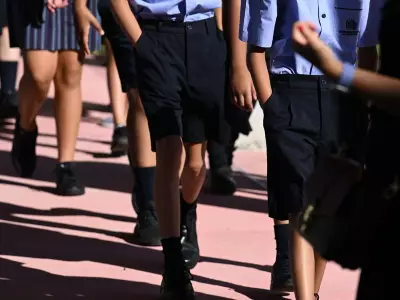
The commencement of a new academic year typically evokes a whirlwind of emotions for families across the nation. There is palpable excitement mingled with nervous anticipation, accompanied by the frantic scramble to procure essential supplies. From backpacks and uniforms to textbooks and electronic devices, the checklist seems endless. Add to that the costs of haircuts, school camps, and excursions, and the financial burden becomes increasingly apparent.
The Glossy Narrative Versus Harsh Reality
Media coverage during this period often focuses on feel-good stories: identical twins starting kindergarten, beaming students in pristine uniforms, and tales of shiny new beginnings. These narratives, while heartwarming, frequently overlook a significant segment of the community. They fail to capture the silent struggles of families grappling with financial hardship, for whom the new school year represents not opportunity, but overwhelming stress.
Dr Liz Allen, a demographer and senior lecturer at the ANU Centre for Social Research, understands this dichotomy intimately. Her own educational journey was far from straightforward. Trauma and circumstances led her to leave mainstream education after year seven. As a young person, she experienced homelessness, pregnancy at sixteen, and the daily challenge of securing basic necessities like clean clothes and transportation.

A Personal Journey from Adversity to Academia
"School wasn't a good time for me," Allen reflects. Her path was marked by instability, including time in out-of-home care. Maintaining employment proved impossible without fundamental resources. Today, her story is one of remarkable transformation. She holds a PhD from a leading Australian university, is a mother of seven, and identifies as a neurodivergent individual who has harnessed her unique perspective as a source of strength.
Allen's academic work in demography provided a crucial revelation: her early struggles were not a personal failing, but rather the result of systemic barriers. "For so long I carried the shame of not having enough, for having lost the lottery of life," she states. This insight fuels her current advocacy.
Opportunity Should Not Depend on Luck
Allen credits her turnaround to serendipitous encounters with supportive educators, not to systemic policy. A TAFE teacher who insisted on university applications, a lecturer who treated her with dignity, and a mentor who suggested a PhD—these moments of chance intervention altered her life's course. "People from where I come from aren't doctors," she recalls thinking at the time.
This reliance on luck, she argues, is fundamentally unjust. A fair society should not leave survival and opportunity to random acts of kindness. "We have the evidence and the means to do better," Allen asserts.
The Concrete Supports That Make a Difference
True support within the education system extends beyond encouraging teachers. It requires deliberate, practical mechanisms. Allen highlights the critical need for provisions like food and travel assistance, and the ability to provide essential items such as shoes or the correct uniform. Sometimes, she notes, the absence of these basic items is the sole reason a child cannot attend school.
She also underscores the vital role of the social security safety net, which has been progressively eroded. "We're now at the point where poverty is built into policy," Allen observes, calling this situation unacceptable. She advocates for increased social security payments for families, particularly for children, to enable them not merely to survive, but to thrive.
Breaking the Cycle of Intergenerational Disadvantage
Without intervention, the gap between the 'haves' and 'have-nots' widens relentlessly. Starting from a lower socioeconomic base creates a compounding disadvantage that affects educational outcomes, post-school training, and employment prospects throughout a person's life. Allen challenges the national myth of the 'fair go,' stating plainly, "Australia isn't the land of the fair go; it's a lie hurting those not getting a go."
Having broken her own cycle of poverty, Allen feels a profound responsibility to pay it forward. "Poverty isn't the fault of an individual," she emphasizes. "Poverty is a social problem that we all share responsibility in tackling."

A Call to Action for Community and Leaders
For many young people and their families, daily life is an exhausting effort to run just to stand still. The sheer energy required for basic survival leaves little room for advancement. As the 2026 school year gets underway, Allen issues a powerful call to action. The continued existence of poverty should, she argues, generate collective fury—a fury potent enough to drive systemic change.
Change begins by listening to those with firsthand experience of hardship. Allen urges political leaders and the broader Canberra community to heed these voices, to take decisive action, and to start building a more equitable support system today. The success of the nation's children, she concludes, is a victory for society as a whole.