
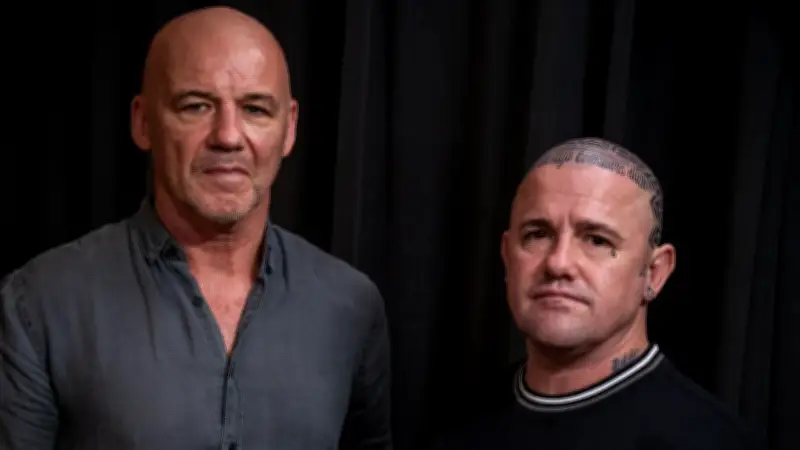
Former gangster and drug dealer turned breathwork facilitator Gaz Wright has revealed to former homicide detective Gary Jubelin that he once called heavily armed tactical police to his home with the intention of forcing them to shoot him in a 'suicide by cop' scenario.
Gripped by deep depression and years of suppressed trauma, Wright explains on this week's episode of the I Catch Killers podcast that he was ready to die. 'My mentality at that stage, my tunnel vision was, well, I'll end up on the front page shot by police. That's the easiest way out,' he says. 'And it'll all finish like a gangster, you know, that was my mentality that time.'
After calling the police station to demand they send a team or he was 'going to hurt someone,' Wright waited with a knife, ready to go out. But his plan was thwarted when his girlfriend at the time begged him to reconsider, and a detective he had known for over 20 years showed rare compassion at the crisis point. When police arrived, Wright fully expected to be arrested, but instead, the detective was genuinely concerned for him.

'He goes, I've known you since you were a kid. You're not OK,' Wright recalls. 'He asked me, How do you feel about me not taking you to prison today, and instead we take you to hospital? I mean, it hit me like a ton of bricks. When the enemy suddenly shows compassion, it just lands different. Like, we literally hated each other.'
On the path to disaster since childhood
A childhood marked by poverty, low boundaries, and early stimulation-seeking behaviour led Wright quickly down a path of criminal activity. 'Being a drug dealer and an active gang member in my community made plenty of sense,' he explains. Influenced by the nineties hip hop scene and gangster films like Scarface, Wright began stealing before he hit puberty. His criminal escalation went from stealing cars and breaking into backyard sheds to coordinating 'smash-and-grabs' by the time he was 15 or 16, progressing after a stint in juvenile detention to selling drugs for senior gang members in the area.
Every dollar came with a price. Wright estimates he spent years waiting to be shot, arrested, or betrayed — and he was right on all counts. By the time he was in his mid-twenties, with a few more stints behind bars under his belt, he had progressed to hardcore dealing. Having stopped taking drugs himself by the age of 18 in order to focus purely on the 'business' side of things, his newfound financial success came hard and fast.
Money, strippers, and fast cars
'I was driving around hundreds of thousands of dollars, BMWs and Mercedes, I had a hair salon [which acted as a front for his drug money], all the stuff, you know,' he tells Jubelin. 'Thumping gold chains, all the stuff that comes with that life.' But despite partying with '10-grand-a-night strippers' and being a frequent high-roller at the casino, Wright's paranoia and panic were already taking their toll. He never kept any drugs or phones at his house, and the building fear of being caught created a near-constant state of anxiety.
'If I was to say to [a law-abiding citizen], listen, we're going to run around in cars that aren't registered in our name. We're going to have houses that aren't registered in our name, we're going to carry guns, we are going to push drugs. If another team comes our way, we are going to have to go to war with them. At any stage, if we slip up, the police can get us, we could do years … also if another team gets a leg up on us, we might be dead. This is what we're gonna do. And this is how we live. It's easy money. It's fast money' … well, they'd have an anxiety attack,' he explains.
This was the version of Gaz Wright the world saw. What was happening underneath would take years — and nearly cost him everything — to surface. He describes a lifestyle that also creates deep sadness and loneliness. 'And that life is a treacherous life,' he says. 'People in that life, they call you brothers … But when you know your brother will put one in the back of your head for the right price … you know, it happens over and over again, you know, mates you've spent your whole life with back to back, next minute they turn on you in the police station … It's a dog eat dog world.'

A whole lot of pain
Wright's decision to leave a life of crime came after facing trial for multiple kidnappings and an assault that injured a 'civilian' couple. Facing a potential 15 to 25 years in prison and dealing with the suicides and overdoses of close associates under the pressure of the trial, he had a 'light bulb moment.' 'I thought, what a s**t career choice. I'm in my mid-thirties and I'm looking at the rest of my life in prison,' he recalls. 'I'd be lucky to get out at 50, if not 60, and I thought man, what have I gone and done? Like there was no amount of, like we talked about before – the chains, the cars, the girls – all the s**t that comes with it, there was no amount of that that was going to outweigh me doing 15 to 25 years in prison.'
After being found acquitted, Wright's determination to live on the straight and narrow was powerful – but so were his demons. It was at this time that he experienced the mental breakdown that resulted in the interaction with the detective who showed him kindness. Unfortunately, it set off a spiralling mental health crisis and addiction that would see him reach his true rock bottom four years later. 'I wasn't going out and snorting bags of coke and going to the clubs,' he says of his time in active addiction, 'I was literally unwashed, starving, and I'd been wearing the same shoes for two years.' 'Any drug I would get my hands on. I had an ice habit, a heroin habit, GHB, weed, alcohol, prescription pills, anything I could get my hands on really. It was the lowest, darkest time in my life.'
The turning point
Stripped of his gang status, Wright lived in fear during these years, on several occasions being violently attacked and stabbed by former enemies who capitalised on his vulnerability. 'The art of war is kick an enemy when they're down, you know, attack them at their weakest,' he says. 'Well, I was at my weakest. Touche for them. Well played. I had multiple drive-bys on locations I was staying at, [I was] stabbed. It was just relentless, and all I had was my own two feet. I didn't have no boys anymore. I had nothing to offer anybody.'
Change finally came when, after breaking his ankle, Wright reached out to his brother for help. He spent weeks in the back room of his brother's house, withdrawing from drugs, completely unmedicated. As soon as he was able, he fled with nothing but his dog Bonnie for Cairns, desperate to make a geographical change as well as a mental one. Once in Cairns, in his first legal job as an adult, Wright began documenting his recovery daily on social media. His videos soon went viral, leading him to create Hope Cartel, a massive online community focused on healing and trauma recovery.
These days, Wright works as a holotropic breathwork facilitator to help other men heal their trauma, and speaks about his experiences to show people that there is an alternative to the anxiety-inducing life he once had. 'If you dip your toes in deep enough, s**t's gonna go down,' he cautions. 'You're gonna lose. It's a lose-lose situation.' Focused on the future, Wright is committed to forward motion with accountability – and his message is ultimately one of positivity. 'I know when I leave this world, I'm gonna leave it having done more right than wrong,' he tells Jubelin. 'Yeah, there were some bad times and yeah, I did some wrong things. I was a nasty person. I'm not gonna lie about it, but there's gonna be a majority of being a good person that overrides that.'