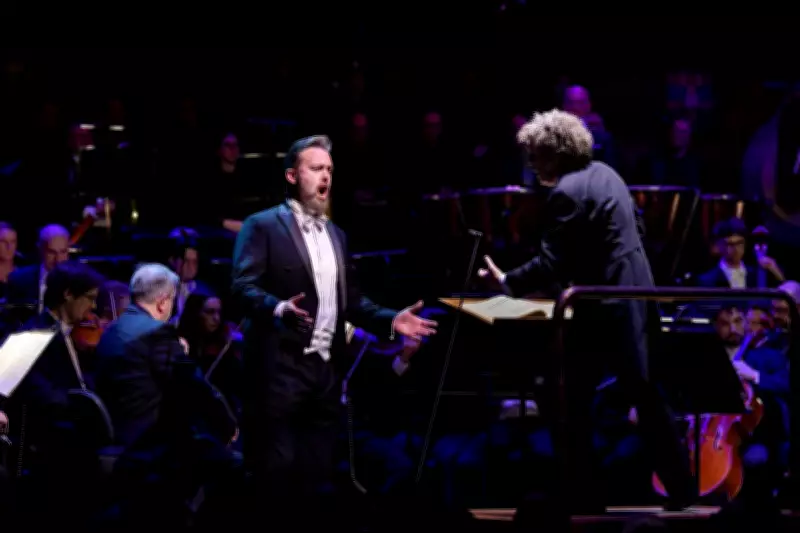
Stentorian horns, surging strings, and ebullient brass broached the storm-tossed tragedy of The Flying Dutchman at Winthrop Hall on Friday as principal conductor Asher Fisch reunited with the WA Symphony Orchestra and his favoured opera composer, Wagner.
Overture and Act I
Mournful woodwind warmed the icy blast of the overture, embracing then calming the fury before another oceanic onslaught while Fisch rode the waves like a seasoned mariner; shaping and directing flurries and cascades of symphonic sound. Dappled blue light etched an eerie seascape and fatalistic phrases rained down with atavistic intent; ebbing then regathering for one last blast.
Orchestral strains settled to open Act I as tenors and basses of the WASO and WA Opera choruses rose to channel seafarers becalmed, with Norwegian ship’s captain Daland (bass Daniel Sumegi) and his Steersman (tenor Andrew Goodwin) on hand to appraise their plight. Sumegi, richly rueful, summed the underlying dilemma: “If you trust the wind, you trust Satan” — hold that thought. Goodwin, full of tuneful yearning, called on the south wind to carry them home; but fate hung on the breeze.

The legendary Dutchman’s clarion call rang out to summon British baritone Christopher Maltman in the title role; a dark brooding presence intoning the terms of his damnation, cursed to sail the oceans for seven years at a stretch in desperate search of a woman’s liberating love. That dilemma forged a magical marriage of vocal mastery and symphonic soundscape as a prayer for Judgment Day found echo in the Dutchman’s ghostly crew. “Who are you?” Daland inquires, evincing a plea for refuge framed in pathos and clinched hubristically with a bargain; the Dutchman’s riches for Daland’s daughter’s hand.
Deft use of surtitles carried the dialogue while Sumegi and Maltman supplied the emotive heft, ably abetted by the orchestra; a devilish deal done. Horns herald the Dutchman’s jubilation as a refreshing south wind brings the crew back in play, weighing anchor to an anthemic exclamation of relief, burnished by brass, for a heroic homecoming.
Act II
Wagner’s vision of the sacred feminine instantly suffused Act II as maritime idioms mixed with folkloric flourishes; soprano and alto choristers spinning and singing to welcome Daland’s daughter Senta (Anna-Louise Cole) and her maid, Mary (Ruth Burke). Burke’s mellow mezzo served as prelude to Cole’s sumptuous soprano; enthralled by the Dutchman’s image and mythic status, diverted by the skittish chorus, yet holding focus with gravity and passion. As the Dutchman’s leitmotif rang out again Cole amplified the legend over ominous orchestral swells, filling the hall with fervid infatuation.
Enter Erik (tenor Paul O’Neill), Senta’s suitor incandescent with a hunter’s desire; his plangent tones blending pain with grace and dignity. With the cast assembled, a powerful sympathy bound the artists and their roles — a symmetry to accentuate suffering. A horn serenade evokes Erik’s dreamscape, a pivotal moment in the plot setting the doomladen trajectory: “She is lost, my dream is true!” his parting shot in the face of Senta’s obsession.
Lush tones summoned romance as Sumegi played matchmaker, crassly conflating cupid and cupidity, while Maltman’s response seemed to reverse the Lorelei legend; a siren song flagging salvation. Cole’s consent, delivered with power and aplomb — “I know well a woman’s sacred duty” — dropped a rock in the well of woke as Sumegi clinched the betrothal with bombastic relish. From there the die was cast as florid orchestral melody unleashed bucolic revels among the chorus, though the Dutchman’s cohort slept on, “like dragons guarding their treasure”. At last the Norwegian townsfolk grasp the enormity of the action.
Act III and Conclusion
Erik rumbles the ruse, exposing Senta’s sellout. His appeal to love and trust stirs the Dutchman’s conscience, who will leave to save her; but she will die to save him. Cole soared above the maelstrom as Maltman exposed the existential hook — “I am the Flying Dutchman!” All recoil in horror but Senta persists, her sacrificial suicide breaking the Dutchman’s curse in an apocalyptic ever after; the charm wound up.