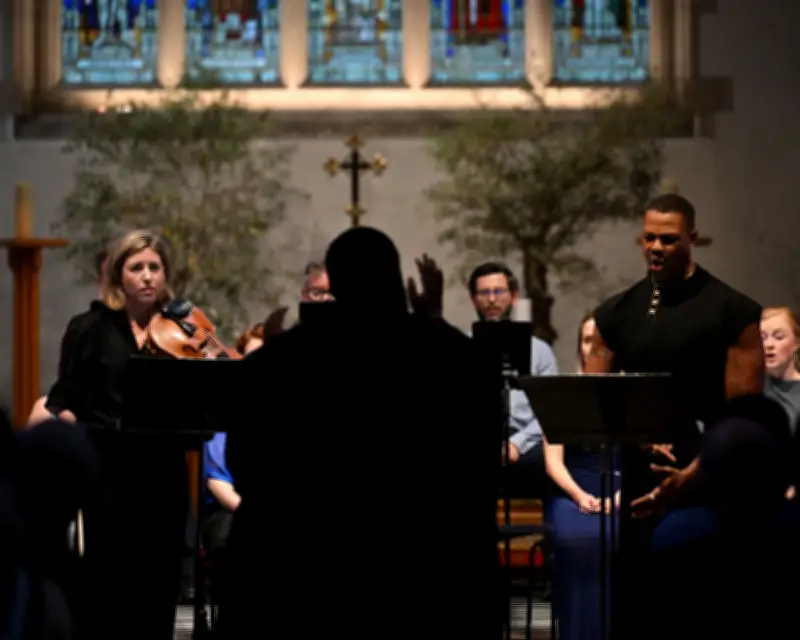
At St Giles Cripplegate, the collaboration between bass-baritone Davone Tines and percussionist Tyshawn Sorey in Tyshawn Sorey’s Monochromatic Light Afterlife was a profound and moving exploration of grief, memory, and transcendence. The piece, composed by Sorey and premiered in 2024, draws on texts from the medieval Persian poet Rumi and the African American spiritual tradition, creating a meditative soundscape that unfolds over 70 minutes.
A Unique Fusion of Voices and Percussion
Tines, known for his powerful and versatile voice, delivered a performance that ranged from whispered fragility to resonant, full-throated lament. Sorey, a MacArthur fellow and virtuoso percussionist, played a vast array of instruments—including marimba, vibraphone, drums, and metal plates—creating a shimmering, evolving tapestry of sound. The interplay between voice and percussion was intimate and conversational, with each gesture and phrase carefully weighted.
The church’s resonant acoustics amplified the work’s spiritual dimension. The piece is structured in sections that shift from sparse, almost silent passages to dense, polyrhythmic climaxes. Tines’s vocal lines often soared above the percussion, while at other times, he blended with the metallic hum of gongs or the soft thud of mallets on drums.

Emotional Depth and Technical Mastery
One of the most striking aspects of the performance was its emotional directness. Tines, who has a background in both opera and contemporary music, brought a raw vulnerability to the text. According to the program notes, the piece is a response to the loss of Sorey’s mother, and this personal grief permeated the performance. The audience was held in a state of hushed attention, with many visibly moved.
Technically, the demands on both performers are immense. Sorey’s percussion parts require extraordinary control and stamina, moving from delicate mallet work to powerful, rhythmic outbursts. Tines navigated wide intervals and extended vocal techniques, including multiphonics and microtonal inflections, with apparent ease.
Context and Reception
The concert was part of the Spitalfields Music festival, which has a history of presenting innovative works in historic venues. The choice of St Giles Cripplegate, a 14th-century church that was heavily damaged in World War II and later restored, added layers of meaning to a piece about mortality and renewal.
Audience reactions were overwhelmingly positive. One attendee described the experience as “a meditation on life and death that felt both ancient and utterly new.” The performance received a standing ovation, with calls for an encore, though Sorey and Tines declined, perhaps to preserve the work’s integrity.
Critical Assessment
While the piece is not easy listening—its length and austerity may challenge some listeners—the emotional payoff is considerable. The duo’s synergy was palpable; Sorey’s percussion seemed to breathe with Tines’s voice. The work’s structure, while seemingly free-form, has a clear arc that builds to a cathartic, if unresolved, conclusion.
In a classical music world often dominated by canonical works, Monochromatic Light Afterlife stands as a testament to the power of new music to address universal themes. Tines and Sorey have created a piece that is both intensely personal and broadly accessible, a rare achievement.