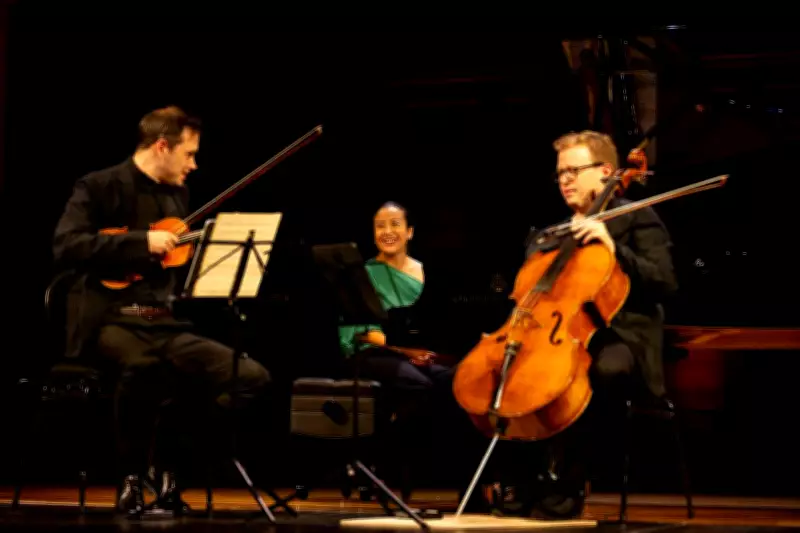
Renowned soloists touring as a threesome summoned Beethoven’s “Ghost” to Winthrop Hall for Musica Viva on Thursday, leading with the Romantic master’s Piano Trio in D major.
Pianist Aura Go, violinist Kristian Winther and cellist Timo-Veikko Valve attacked the opening Allegro movement with robust technique and expression, brightening a cloudy autumn day.
The aptly named Go unleashed a flurry of notes, sustaining her colleagues in florid melody with delicate runs and trills. Lyrical flourishes of the bow fed off her energy through gentle discourse and intense emotion, rumbling to a dramatic dismount.

Enter the “Ghost” of the title in the Largo middle movement; a rustling of strings and ethereal response in piano rising to a tempestuous peak then tumbling to eerie rumination.
Legend links this haunting interlude to Hamlet and/or Macbeth; both Shakespeare tragedies hinging on ghostly visitation to gory effect. Happily the trio found more comfort in the drama; darkly emotive yet consoling in warm phrases interspersed with frenetic outbursts, resolving to calm.
Agile piano stirred fresh endeavour in the Presto finale, as violin and cello rode a bow wave to chime in with precision and panache over fluid runs and touches of whimsy, down to an ebullient conclusion.
World Premiere and Other Works
Fast forward to 2026, a world premiere of Regnare, by Melody Eotvos, evoked Eucalyptus regnans, or Mountain Ash; the world’s tallest flowering plant, “one of the royals of our ecosystem”.
Piano again served as catalyst in deep perturbations drawing violin and cello to airy, disjointed musing, like wind-blown boughs high above a shady forest floor.
All three swayed with the breeze, agitated then stilled by turn, with hurried, furtive piano lending mystery to the mix. Go’s inexorable verve opened vistas for strings to navigate in rolling waves of atmospheric sound, flowing to a sudden silence.
From nature’s abundance to the twilight of life, Lili Boulanger’s last work, D’un Soir Triste (Of a Sad Evening), opened in solemn crushed chords and melancholy cello; a parting shot full of pathos from the chaos of 1918.
Violin echoed the lament, rising above stark tones in piano and cello with a lightly insistent air. Piano reset in the bass register, tolling ominously to draw in strings now more muted; ascending to harmonics over an intricate twinkling of the ivories.
Broader bowing in violin-cello duet lifted with plangent piano then fell back to more sombre meditation, fading to close.
Ravel’s Piano Trio rounded out the bill, a work leaning more to dawn than dusk amid the onset of World War I.
Lilting strains led swiftly to striving melody as three clear voices intertwined in questing phrases, as if blinking in sunshine. Quiet contemplation offered contrast, settling to a blissful cadence.
Skittish interplay characterised the “Assez vif” (Quite lively) second movement, patterned on a “Pantoum” poetic form of repeated couplets. Go was again in the driving seat as strings wove playful threads around her, breaking to a jump-cut conclusion.
A walking piano bass set an ambulatory pace for the slow Passacaglia third movement, with violin and cello taking the lead in turn. Funereal pomp suffused the evolving theme, an anguished prelude to war with folkloric echoes, returning to its origin in solemn bass.
Shimmering strings and quicksilver piano cast a glimmer of light in the finale, rising to a dramatic clash of styles then coalescing in grandiose exclamation at the death.
Upcoming Performance
Musica Viva returns to the Regal Theatre, Subiaco, on June 28 with Doric String Quartet and Lloyd Van’t Hoff.