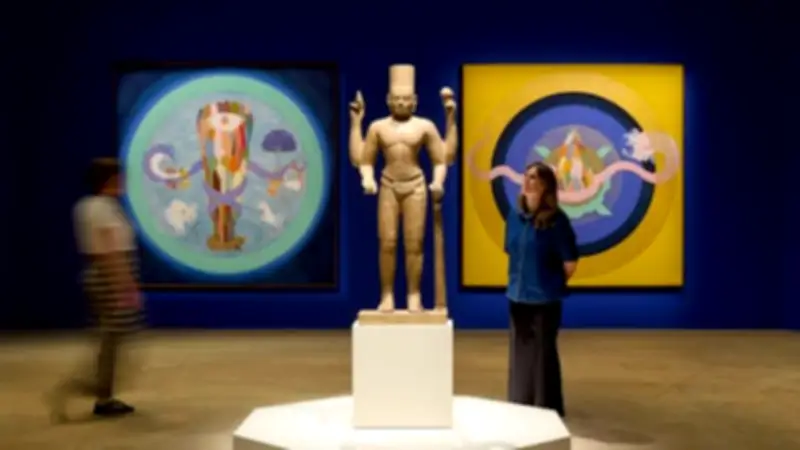
The Art Gallery of New South Wales (AGNSW) has opened a landmark exhibition, Avatar: Forms of Vishnu, featuring 200 artworks that trace 1,500 years of artistic devotion to the Hindu deity Vishnu. The exhibition, running until October 5, draws from international and Australian collections, with many objects—including early Cambodian sculptures—travelling abroad for the first time.
A Deep Dive into Vishnu's Avatars
The word 'avatar' derives from the Sanskrit avatāra, meaning 'descent'. In Hindu tradition, Vishnu descends to earth in various forms to restore cosmic order. Co-curator Chaitanya Sambrani described Vishnu as 'a being that is everywhere, everything, and in everyone; an omnipresent force with different personas'. The exhibition explores this concept through diverse media: textiles, carving, gold, embroidery, paint, sculpture, bronze, papercuts and watercolour.
Historic and Contemporary Works Juxtaposed
Highlights include a carved sandstone Vishnu from early 9th-century Cambodia, depicting the four-armed lord holding a discus, conch, club and globe. Behind it hang two large contemporary paintings by Desmond Lazaro, including Samudra Manthana, Churning of the Ocean of Milk (2026), created with hand-ground ochres. The exhibition also features a 13th-century soapstone carving of Lakshmi Narasimha, Vishnu's man-lion avatar, framed by Sumakshi Singh's 2026 installation Threshold in cotton and silk.

Relevance to Contemporary Issues
Sambrani noted the exhibition's prescience amid political division, ecological instability and identity debates. 'We may have our own personal experience of Vishnu beyond the limitations of the self,' he said. The exhibition highlights feminist themes, emphasising the shakti energy from female consorts as crucial to Vishnu's avatars.
Final Gallery: Vishnu's Cosmos
The final section, 'Vishnu's Cosmos', includes a vibrant Kaavad shrine (2015) by Satyanarayan Suthar, blending cars and planes with gods and goddesses. A series of printed oleographs from Ravi Varma Press (1894–1972) are decorated with embroidery and sequins. A sandstone carving of Vajimukha (Hayagriva or Kalkin) from the late 500s or early 600s guards the space, its horsehead referencing Vishnu's final avatar Kalki, prophesied to usher in a new age of truth.
First Australian Exhibition Devoted to Vishnu
This is the first Australian exhibition dedicated to Vishnu and the largest to focus on South and Southeast Asian art in 20 years. It acknowledges Australia's evolving cultural landscape and the growing proportion of Australians with South and Southeast Asian heritage. The exhibition positions mythology as an adaptive visual language for exploring identity, resilience, morality, devotion and human transformation.