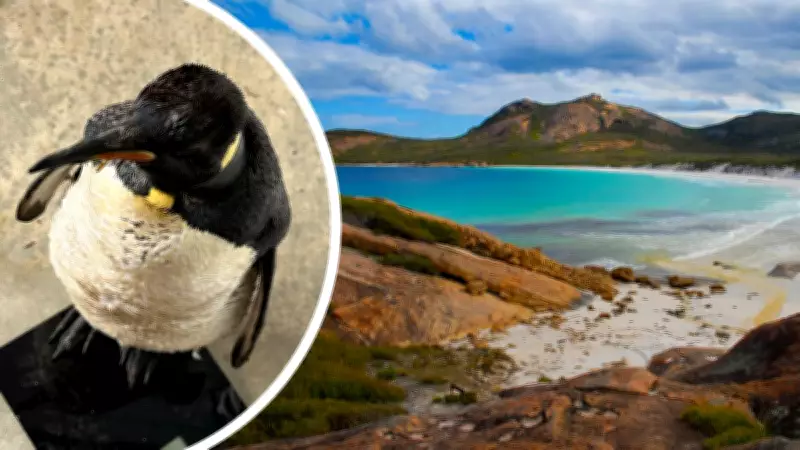
King Penguin's Incredible 4000km Swim to Esperance Beach
A king penguin has been discovered on Quagi Beach near Esperance, Western Australia, an astonishing 4000 kilometres from its natural sub-Antarctic habitat. The bird, affectionately named Hope, likely swam through complex ocean currents for up to two months before being spotted by campers in early March.
Rare Sighting Triggers Wildlife Rescue
The campers recognised the penguin as a king penguin far from home and immediately contacted Lori-Ann Shibish, a wildlife rescuer at Esperance Wildlife Hospital. Ms Shibish initially assumed it would be a little penguin, a breed more common to the area. "Little penguins breed here on the islands of the archipelago, and that's what we usually encounter," she said. However, upon receiving a photo, she was shocked to confirm it was indeed a king penguin.
King penguins typically inhabit sub-Antarctic islands like Heard Island and Macquarie Island, swimming hundreds to thousands of kilometres for food before returning. "For some reason, this penguin was just swimming and swimming and then was too far away," Ms Shibish explained. This marks only the second time a king penguin has been seen on the Australian mainland, with the last occurrence also in Esperance in 2021.

Biosecurity Concerns and Health Checks
The arrival of this non-native bird prompted a strong biosecurity response, especially after the highly pathogenic H5N1 bird flu was confirmed on Heard Island late last year. Both Heard Island and Macquarie Island, primary habitats for king penguins, have been contaminated with bird flu. Ms Shibish safely secured the penguin using a specialised avian influenza grab kit from Murdoch University, and it was taken to a quarantine pen at the wildlife hospital.
Laboratory analysis of swabs and blood samples confirmed the penguin was free of both H5N1 and Newcastle disease, allowing the hospital to focus on rehabilitation. The penguin had come ashore to undergo a catastrophic moult, a process where seabirds shed all their feathers and grow new ones over about a month. "Had it just been left on the beach, it would have been killed within a day or two by feral animals because it couldn't go back in the water," Ms Shibish noted.
Hope's Recovery and Future Release
The penguin, named Hope to inspire positivity, was found underweight at only 10 kilograms instead of the expected 16 kilograms. "Having to stand there for a month with no feed and lose more weight was going to be a real risk to its health," Ms Shibish said. Currently, Hope is eating 1 kilogram of fish daily at the wildlife hospital and must gain six kilograms and complete her moult before release.
"By the time she has finished her moult and has waterproofed her feathers, she will have optimum weight to be able to have the energy to swim back home," Ms Shibish added. Once ready, Hope will be released near Quagi Beach in the hope she finds her way home. Ms Shibish emphasised that this story serves as a reminder for the public to keep a distance from out-of-place wildlife and report sightings immediately.