A Day in Khiva: From Desert Dawn to Silk Road Moonrise
Stephen Scourfield revisits the timeless walled city of Khiva, Uzbekistan, capturing its rhythms from first light to evening shadows.
Morning: Awakening in an Ancient Citadel
The day begins with the gentle, rhythmic sound of sweeping. Brooms with thin, blond bristles waft the fine dust of the Kyzyl Kum Desert into amber shafts of early sunlight. This quiet activity is accompanied by the melodic, sing-song conversation in Uzbek – the dawn chatter of a city stirring to life. These streams of Uzbek words echo around the remote, medieval walled city of Khiva, nestled in the vast deserts of Central Asia.
Khiva's history stretches back to the sixth century. Its earliest inhabitants migrated from nearby Iran. Over time, Turkic speakers became the majority, and Muslim beliefs gradually replaced Zoroastrianism, a shift largely encouraged by tax relief offered by the ruling Khan of Khiva in the seventh century.
Remarkably, Khiva has been destroyed and rebuilt ten times throughout its long existence, including once by the army of Genghis Khan and again by the Uzbek ruler Emir Temur. In 1873, forces of the Russian Empire seized the town, which was later absorbed into the Soviet Union in 1924. Uzbekistan gained its independence in 1991 following the collapse of the Soviet Union, but the walled town of Khiva had already earned its place on the world stage, being listed by UNESCO a year prior.
The inner town, known as Itchan Kala, is protected by formidable brick walls soaring up to 10 metres high. These walls served as the last resting place for caravans before they embarked on the perilous desert crossing to Iran. While their foundations date to the 10th century, the present-day 10-metre faces and crenellations were constructed in the late 17th century. Today, they largely serve to enclose and guide the flow of tourists through this living museum.
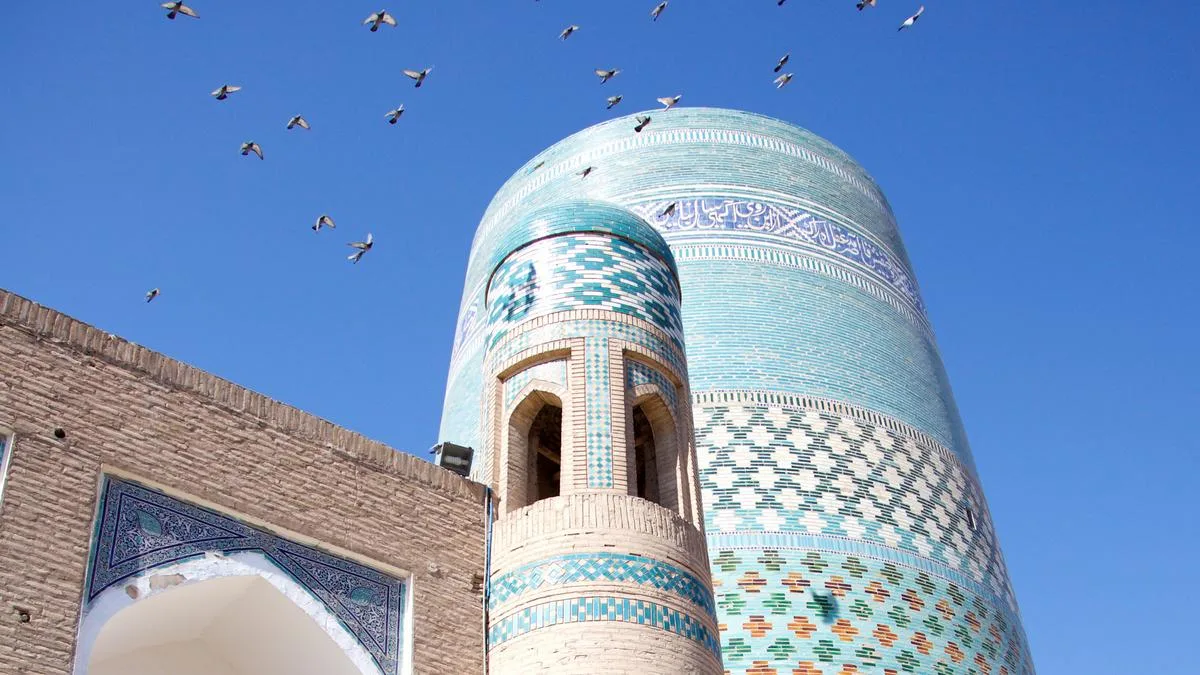
I am staying at the Orient Star Hotel Khiva, a beautifully converted madrasah, or Islamic school. This was once the largest madrasah in Khiva, dating from the 19th century, and was transformed into a hotel in the 1970s. It has aged gracefully. The building features a large courtyard adorned with intricate mosaics in shades of blue and turquoise, and it stands right beside a massive minaret with a base diameter exceeding 14 metres.
A local legend surrounds this minaret. It is said that during its construction, an official climbed the tower to check on progress and realised he could see over the wall into the Khan's adjacent harem, where he glimpsed the unveiled women inside. Consequently, work was abruptly halted, leaving the minaret at just 26 metres tall.
Khiva's layered story gently unfolds during a morning stroll. In contrast to the unfinished minaret, the city also boasts the tallest minaret in Uzbekistan, beautifully banded with decorative patterns. The old citadel, which served as the Khans' palace, contains three courtyards and the harem where young girls, sometimes as young as eight, were brought and often expelled by the age of 18. Many were given up by families unable to pay their taxes.
Itchan Kala is home to more than 50 historic monuments, but it remains a living community with over 200 homes and approximately 3,000 residents. Most dwellings were constructed in the 18th and 19th centuries. I pause to watch three men mixing mud and straw by hand, crafting a new wall using the same ancient techniques that have defined this architecture for centuries.
The Djuma mosque, originally built in the 10th century and rebuilt in 1788, is a stunning wooden structure dominated by 200 intricately carved timber columns – a feast for the eyes, though apparently also beloved by white ants.
Afternoon: Markets and the Pulse of Daily Life
The climate here is one of extremes. Daytime temperatures can soar to a scorching 48°C in the summer. "In the shade," a local emphasises to me with a wry smile. Yet winter arrives swiftly and brutally, with recorded temperatures plunging as low as -30°C – a staggering annual range of over 70 degrees.
This extreme weather is reflected in the market stalls. Thick, long-lasting knitted wool socks, selling for about $3 a pair, dominate the offerings. Elaborate fur hats, many imported from Russia, are also prominently displayed. In the summer heat, they appear bizarre, yet they stand as a stark reminder of the harsh winter that will inevitably arrive.
I wander through courtyards paved with brilliant blue tiles and mosaics, and others that are vast, sun-drenched spaces. I notice circular platforms where woollen felt yurts, or tents, would have been erected during the winter months for warmth.
There were originally 11 gates punctuating the town's 2,200-metre-long walls, but only four remain today. I step through one of these gates into the outer town, known as Dichan Kala, on a mission for some everyday shopping – deodorant and toothpaste. It is a refreshing pleasure to shop for ordinary items, not souvenirs, in everyday local shops. As I walk through the folks' bazaar, partly open-air and partly under a roof, I am the only Westerner in sight. Moving past stalls of fresh produce and butcheries, I finally find a stall with an eclectic mix of household products. Through sign language and with the amused help of several bystanders, we agree on a price, and I am warmly farewelled.
Back inside the ancient walls, I am herded back into the world of tourism. Khiva is bustling with European visitors. While Uzbekistan was once off the beaten track for many tourists – attracting around two million visitors in 2015 – it saw a dramatic rise to 11.7 million foreign visitors in 2025, a surge of nearly 47 per cent compared to the same period in 2024. Of this number, only about a million will find their way to the historic city of Khiva.
Uzbekistan is a Muslim-majority nation but is known for its secular, tolerant, and temperate nature. I am repeatedly told a local proverb: "Hospitality is rated higher than courage."
Seeking respite from the intense afternoon light, I retreat down a tunnel-like passage to my room. It is dark and spacious, with a large bathroom. I open the small, high window, and the vivid sights and sounds of the day flood back in.
Evening: Moonrise Over the Silk Road
The moon is full tonight. It ascends through a haze of dust, glowing within a golden sunset. This celestial sight has a profound connection to this very place and moment. On the far side of the moon, there is a crater named Al-Khwarizmi.
It is named for Muhammad ibn Musa al-Khwarizmi, a scholar who lived from approximately AD 780 to 850. He is credited with establishing the foundational principles of both algebra and trigonometry. Around AD 830, he authored The Compendious Book on Calculation by Completion and Balancing, a detailed treatise on solving polynomial equations. From his name and work, we derive the term "algorithm," referring to the technique of arithmetic using Hindu-Arabic numerals that he developed. He is considered the father of the algorithm, and from this ancient root grows the entire tree of digital development that powers our phones, computers, and tablets.
Yet, standing here, all those digital connections fall away. I am on the highest lookout point on the city wall, watching that same moon rise as the daylight fades. The minarets around me begin to glow, taking on the magical quality of the spiritual lighthouses for which they were originally named.
Down among the old houses of Itchan Kala, some souvenir sellers are packing up their wares, while others are preparing for the evening trade. Lights twinkle on in the many good restaurants, and the first notes from musicians begin to drift through the warm air.
The evening is mellow. A desert wind starts to push through the ancient streets, carrying the scent of dust and history. Night is coming.
Suddenly, everyone else departs down the steep, narrow steps. I find myself alone, high above this ancient city – this historic staging post, this caravanserai on the legendary Great Silk Road – bathed in the silent light of the moon.