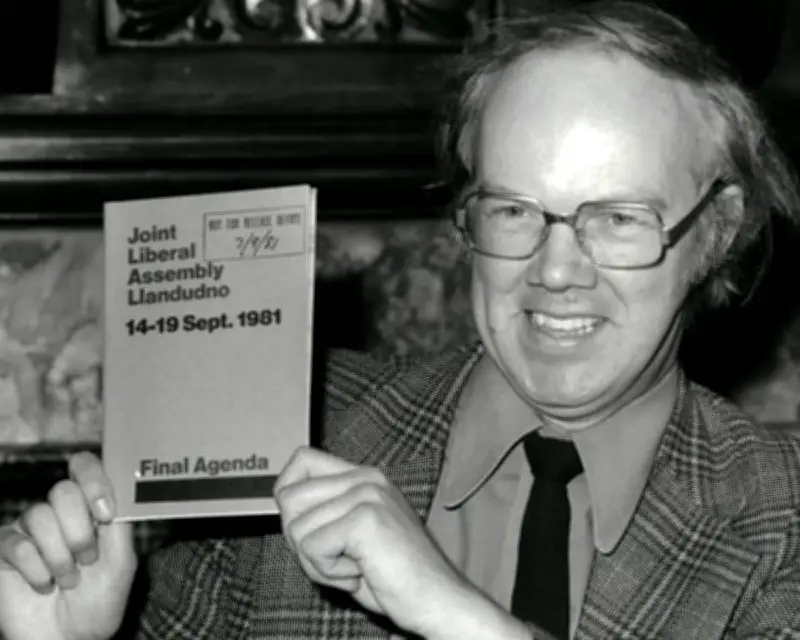
Michael Meadowcroft, who has died aged 84 after a short illness, was a Yorkshire Liberal politician and activist of great resource and flair. He constantly wrong-footed Labour in its former heartlands in Leeds as a nimble source of new ideas, closely in touch with voters and patient at working with them to get local problems solved.
He served as a Liberal party member of Leeds city council from 1968 to 1983, and then as an MP for Leeds West for four years. Meadowcroft was famously the only MP in the city’s history who led a weekend jazz ensemble in the main shopping precinct, pausing between numbers to discuss political issues with passers-by.
Exuberantly self-confident, he was a natural challenger with less interest in becoming part of any status quo. But he was steeped in Liberal philosophy as well as being a rigorous organiser, central to the party’s adoption of “community politics” during its resurgence under the charismatic leadership of Jo Grimond in the 1960s.

Early life and career
He was born in Elland, West Yorkshire, the eldest of three sons of Phyllis (nee Hanson), a blanket weaver, and Norman, a railway booking clerk, who had been a conscientious objector and served in the Royal Army Medical Corps during the second world war. Meadowcroft grew up in a council house, in Southport, Lancashire, after his father was transferred to the town.
He was educated at Churchtown primary, a bright and encouraging school, and then the highly conventional King George V grammar, which he left at 16 when his father lost his job and became ill. Meadowcroft found work as a bank clerk to help support the family before exploring wider horizons when his hereditary support for Labour shifted to the Liberals as more effective challengers of Southport’s Conservative council.
Local activism led to an organising post at Liberal headquarters in London, where he worked closely with the national agent Pratap Chitnis, who masterminded the Liberal party triumph at the Orpington byelection in 1962. This began the “Liberal Revival” after three lean decades and Meadowcroft repeated the pattern when he returned to the north in 1967 as secretary to the Yorkshire Liberal Federation. The following year he joined two fellow activists as the first Liberal councillors in Leeds for 38 years, breaking through in Labour strongholds rather than Tory wards where more demure, less knockabout Liberals had battled endlessly in vain.
Political achievements and philosophy
He combined council work during a heady time for Leeds’ prosperity with working as assistant secretary of the Joseph Rowntree Reform Trust and later secretary of the council for voluntary service in Bradford. He realised his youthful university capabilities in 1978 by taking an MPhil at Bradford University on political history in Leeds, a subject which absorbed him for the rest of his life.
Five years later, after a stint on West Yorkshire county council, Meadowcroft won election as MP for Leeds West, against the national expectations of both political commentators and Liberal HQ. But his four years at Westminster were more frustrating than fulfilling. His long-considered and deeply felt Liberal credo had little room for social democrats; he feared the socialist spider would swallow the liberal fly. Parliament meanwhile seemed stuffy and cobwebbed compared to pragmatic council work.
He was also increasingly interested in the promotion of democracy and liberalism internationally, so defeat by Labour’s John Battle in 1987 proved a release, although he did fight the seat one more time in the 1992 general election. He also overcame his political arachnophobia by joining the Liberal Democrats in 2007.
Later life and legacy
As chair of the Electoral Reform Society (1989-93), and after a stint as a senior visiting fellow at the Policy Studies Institute, Meadowcroft led or took part in 50 missions to 39 emerging democracies. This coincided happily with time to spend on his personal love of other countries, especially France, where he had a share in a cottage and enjoyed telling local friends that he was also French and had been born in Elland by mistake.

He devoted more time to music and drama; the arrival in Leeds of both the new West Yorkshire Playhouse and Opera North during his council term had given him particular pleasure and he and his second wife, Liz Bee – a librarian, fellow musician and Liberal campaigner whom he married in 1987 – hosted visiting artists at their former millowner’s home in west Leeds for some 40 years.
He was also a vigorous committee member of local organisations such as the Leeds Philosophical and Literary Society and especially the venerable Leeds Library, whose founders in 1768 included Joseph Priestley. There, Meadowcroft lectured entertainingly on Leeds’ historical figures and wrote prolifically as a columnist for the Times and Yorkshire Post and as a frequent contributor to the Guardian, which he had read since the closure of the News Chronicle in 1960 when his family chose it in preference to their newsagent’s offer of the Daily Mail.
His pamphlets and books were published by small imprints but remain influential in discussions of Liberalism, especially a record of debates in 1980 with David Marquand on Liberalism and Social Democracy and Diversity in Danger: Pluralism and Policy Development, published in 1989 and again in 2009. He left the Liberals on their merger with the SDP in 1988 and set up a “continuing Liberal” party which failed to prosper; but in later years he unfailingly encouraged young or new liberals wherever they were to be found.
Family and survivors
In 1967 he married Eluned Lloyd Jones, a teacher and Liberal party activist, and they had a son, Andrew, and a daughter, Ruth. They divorced in 1987 and she died in 2020. He is survived by Liz, his two children, seven grandchildren, four great-grandchildren, and a brother, Robert.
Michael James Meadowcroft, politician, writer and public affairs consultant, born 6 March 1942; died 1 June 2026.