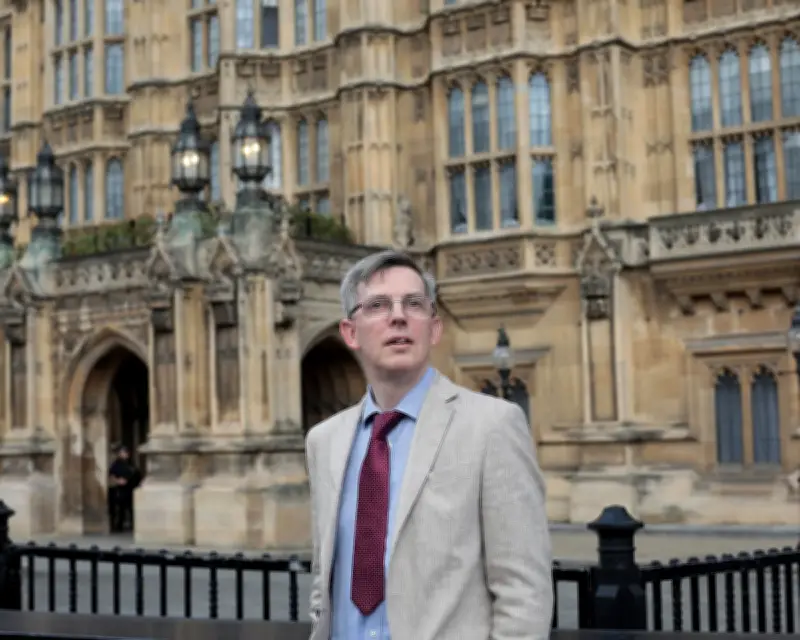
Andrew Sparrow has been writing the Guardian's daily political live blog for more than 15 years. How does he cope with the relentless psychodrama of British politics?
On Monday at 14:12 BST, the Guardian's Andrew Sparrow posted two sentences announcing one of the largest government document dumps in British political history: 'The Cabinet Office has published the Mandelson files. They are in three volumes.' Andrew writes the Guardian's daily live blog, Politics with Andrew Sparrow, and that 14:12 update was followed by a series of posts exploring the trove of files relating to the government's disastrous appointment of Peter Mandelson as the UK's ambassador to Washington. Mandelson was sacked last year after fresh revelations about the closeness of his friendship with the late sex offender Jeffery Epstein. More than 1,000 documents were released this week, the contents ranging from emails and official memos to handwritten notes and WhatsApp messages. The sheer scope of the disclosures made the live blog the ideal format for keeping our audience informed. And Andrew was the ideal journalist for the job: he basically pioneered this format for covering unfolding political events when he started liveblogging UK politics for the Guardian back in 2009.
Back then, Andrew felt that a live blog offered the best way to cover the public inquiry into the UK government's handling of the Iraq war – which involved an even larger release of government documents. Indeed, shortly before 9am on Monday, Andrew drew on this very experience to post valuable insights and perspectives for the day ahead. Here are some snippets from that opening post: 'Many people despair at the quality of governance in Britain at the moment, but in one respect we are living through a golden age; if you are interested in contemporary history, and learning about what actually happens at the heart of government, then you can now – sometimes – access the sort of information never available before … Last month a minister compared [the documents being published today] to the evidence released as part of the Chilcot inquiry into the Iraq war. But the Chilcot inquiry took place in the era before WhatsApp, and it was publishing secret memos – intended for circulation within Whitehall. WhatsApp messages are a lot more personal; reading them is like being able to eavesdrop on a private conversation.'

It's the kind of deep context that Andrew needs at the tips of his fingers. The job requires speedy analysis, strong news judgement, the ability to pull in different media sources, engage with readers in real time, and coordinate with other colleagues and draw on their knowledge. It's demanding work at the best of times. And of course, when it comes to British politics, these are hardly the best of times. In the years since Andrew started liveblogging for the Guardian, there have been seven prime ministers as the country has pinballed between crisis and psychodrama. I spoke to him ahead of this week's revelations to ask how on earth he manages.

How do you avoid getting desensitised to all the drama?
Andrew, in recent years British politics has felt like a bit of a dumpster fire, and now there's the possibility the UK will burn through yet another prime minister. How do you avoid getting desensitised to all the drama? In some ways, the various crises have been hugely exciting because work has never been boring and people have been really interested in British politics. There's been a mix of personality dramas, policy and parliamentary process. Parliament has been at the centre of what's happening in the country in lots of ways and I'm a parliamentary specialist, so professionally I've enjoyed it. But, at the same time, as a citizen you think the country's going to hell in a handcart. Journalists have to juggle those conflicting emotions. However, one difficulty I have is with the tension between the personalities and the issues. A lot of readers sense, and I agree with them up to a point, that if political journalism is all about 'is this person going to resign tomorrow' and so forth, then you completely lose sight of the function of government in democratic society, which is to make big choices after weighing up the consequences. And there's an argument that journalism should be explaining the issues rather than focusing on these kinds of micro dramas. And I agree with that because at the end of the day, these come and go. But people are intensely interested in them. And of course, who the prime minister is and who other personalities are is consequential and impacts all the broader aspects of politics. So there's a balancing act that I think anyone in public-interest journalism is doing the whole time, but it's become harder and harder when the Westminster drama starts to lose touch with what else is happening in the world and just gets more extreme.
How do you manage with the relentlessness of the live blog?
Lots of people look at my routine and think it must be really stressful because when you're liveblogging you tend not to take lunch and you're pretty much on it and thinking on your feet the whole time. And it's true that I don't tend to leave my desk – I don't take a long lunch or go for a coffee with a contact because I find that you lose track of all sorts of news threads that are on the go. But on the other hand, when the day finishes and I go home, unlike other colleagues who work with me in Westminster, I don't have to worry about whether I'm going to get scooped by a rival news outlet or if I'm going to get phoned up by the newsdesk at 10.30pm asking if I can stand up this or that story. So it's an alternative form of stress, but it's one that I find quite manageable.
How has the job changed since you started liveblogging?
When I joined the Guardian as a political correspondent for the online operation, web journalism was really far down the pecking order – there was a newspaper newsroom and then, three floors up, an online newsroom. But I was interested in the online world. To begin with, I was updating online stories continuously during the day. The Guardian was publishing live blogs for sports and cultural events, but no one had quite worked out how to use them for news events. I started our politics live blog in 2010 and it took off and became a regular thing, but it effectively started when the Iraq war inquiry began in the autumn of 2009. That provided ideal material for a blog because there was so much good material coming out but there was no way you could cover it properly with just one 600-word news story three times a day. The inquiry was also publishing a lot of material online so the blog gave us the capacity to flag up documents and say, 'Look, they're talking about this, you can read it here, this is the key quote, and here's a quick explanation of why it matters.' It was a format that worked really well. Then there was a shift that began with the referendum on Scottish independence. That was when I first started to notice readers getting engaged online in a really populist, hostile, organised way. It didn't get as unpleasant as it did with Brexit but as the online ecosystem has evolved and algorithms reward stories that engage your emotions rather than your intellect, the media and politics in general have become more polarised. I think we navigate that successfully but it's more difficult than it was when I was working as a print journalist. Another difficult thing about the transition was being exposed to reader scrutiny minute by minute on social media or having comments open on the blog – which is mostly something I've really enjoyed and found useful, but it does mean you're exposed to constant challenge in a way that I never was before.
How does liveblogging differ from 24-hour TV news?
In some ways, it's a symbiotic relationship with 24-hour news: I take from them but also they take from us. What I try to do, though, is write the blog in such a way that it serves a different function by putting things on the record in a way that is searchable. In one respect I'm creating an archive of what was interesting on any particular political topic on any particular day. Rolling TV news isn't usually searchable in that way. It flows and then it disappears … and also repeats itself endlessly, which my blog doesn't. What 24-hour broadcast news can do, though, and I suppose I try to emulate it, is bring in different voices. My version of that has been not just reporting what people say, but trying to find intelligent, interesting comments from elsewhere. That's become harder since Elon Musk took over what was previously known as Twitter because there was a time when there was ready access to a high-grade commentary on Twitter with a lot of voices out there saying interesting stuff that was worth aggregating and editing and filtering. It's harder to find that now. But I do look on other platforms such as Bluesky, and I also ask people to comment below the line on the blog or message me.