
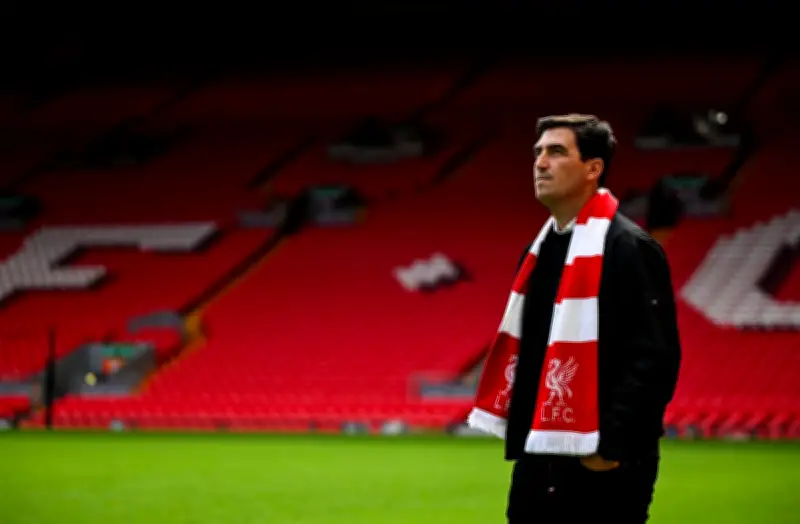
There comes a point in most discussions when all the detail and complications fall away and the issue can be crystallised into a single straightforward question. For Liverpool that became: do they have more chance of challenging for the league title next season under Arne Slot or Andoni Iraola? Put like that, the answer was clear and so Slot was replaced.
That answer may seem counterintuitive. Slot won the Premier League last year and Iraola has never so much as managed a club in Europe. There will be those who see the decision, and the widespread consensus that it was the right thing to do, as evidence of football's impatience. Perhaps it is. Perhaps Slot next season at Anfield, in less testing circumstances, could have regained the confidence of the dressing room and reinvigorated the side. But in management that is very rare.
Bela Guttmann observed that being a football manager was like being a lion tamer: the slightest sign of fear and he is lost. A club owner I met recently spoke of being able to recognise the moment when a light goes out in a manager's eyes, when their judgment goes, paranoia takes over and they begin railing against enemies, real and imagined, who are undermining them. Slot perhaps didn't quite reach that stage, but there was a sense by the final games of the season that his relationship with the fans and his squad had reached a point of no return. The number of players liking Mohamed Salah's Instagram post criticising Slot made it very hard to believe there was any way back.

But just because Slot had ceased to be the right man, does that necessarily make Iraola the right man? Any time a super club makes an appointment from outside the elite there is a risk. The demands of a job at Liverpool are almost incomprehensibly different from the ones at Bournemouth. Last summer there was a widespread sense that Thomas Frank, who had seemed so affable and wise at Brentford, would prove a smart appointment for Tottenham. He lasted until February, by which point Spurs were sinking towards a relegation scrap. He had begun by almost beating Paris Saint-Germain in the Super Cup but he quickly came to seem a diminished figure, almost visibly shrinking in the job, his geniality withering in contact with the harsh reality of the task, certain players openly dismissive of his authority.
Iraola seems similarly even-tempered and in control, but the truth is there is no way of knowing how he will adjust to the radically increased exposure. Bournemouth drew 18 league games in the 2025-26 season, something that passes almost unnoticed for them, but would draw intense scrutiny at Liverpool.
Only Newcastle dropped more points from winning positions than Bournemouth. They were ahead in 23 league games but ended up drawing eight and losing two of them. Perhaps that reflects Bournemouth's relative paucity of resources and will be resolved simply by being at a team that habitually has options from the bench. But perhaps not. Certainly if Liverpool give away a lead in the first few weeks of the season, he should expect questions about that tendency.
That's why there must be a doubt. But there are also numerous reasons for optimism. Iraola has done a remarkable job in the circumstances. Bournemouth have pushed close to the threshold of profitability and sustainability regulations but still coped with the 17th-highest wage bill in the league last season. Last summer, Iraola lost his goalkeeper and three of his regular back four, as well as a forward who had scored seven goals the previous season, then lost his best attacking player in January, yet they still finished sixth. That is an astonishing achievement.

Iraola's style of play would seem a good fit for Liverpool. Bournemouth tend to be a good side to watch, their football progressive and dynamic, with none of the passivity that came to characterise Slot's Liverpool at their worst. The 4-2-3-1 shape Iraola has tended to favour would seem to fit with at least some of Liverpool's thinking over the past year. Florian Wirtz should thrive in the central creative role largely occupied by Eli Junior Kroupi this season. The full-backs are attacking, as Bournemouth's have been; for Milos Kerkez, who recovered towards the end of the season after a difficult start at Liverpool, this will be a reunion with Iraola, a coach to whom he felt so well disposed at Bournemouth that he celebrated an assist against Tottenham by running to the technical area to acknowledge his role in the goal.
Bournemouth pressed so hard over Iraola's three seasons in charge that no side had more shots after winning the ball back in the final third, which for Liverpool sounds like a return to something approaching a Jürgen Klopp-style gegenpressing after the restraint of Slot (although Liverpool were joint fourth in that metric over the same period). Slot's control was seen as positive in 2024-25 but, even if there is an argument for restraint given modern workloads, after the flatness of recent performances any semblance of the old energy will be welcomed.
Iraola feels a good fit for Liverpool, as a club and a squad. Nothing in his management career so far has said he does not have the temperament for the job. But Liverpool represents a different challenge to anything Iraola has come up against so far – and that means there can be no guarantees.