On April 25, Australians pause to mark Anzac Day — a national day of remembrance honouring those who served and died in war. Across the country, communities gather at dawn services, marches and memorials, taking part in traditions that have become deeply embedded in Australian life.
While many of these moments are instantly recognisable, their origins are often less well known. Many trace back to World War I, shaped by the experiences of soldiers and how communities chose to remember them. So where did these traditions come from, and how did they become such a central part of Anzac Day?
Dawn services
Dawn services trace back to a wartime routine known as “stand-to” during World War I. In the trenches of Gallipoli, the Western Front and the Middle East, soldiers were woken before sunrise when enemy attacks were most common. The half-light made it easier for an enemy to strike, with shadows and low visibility creating uncertainty on the battlefield. In the dark, troops would fix their bayonets and take position, ready to defend against an attack as the day broke. The timing also reflects the moment troops landed at Gallipoli on April 25, 1915, just as the sun was rising.

Commemorations for those who died in World War I began as early as 1916, but the term dawn service did not come into use until the 1920s. One of the earliest recorded services was held in Albany in 1923 by Reverend Arthur White, a former army chaplain. The first official wreath-laying dawn service followed a few years later — on Anzac Day 1928 — at the Sydney Cenotaph in Martin Place. Today, dawn services are the most widely recognised form of Anzac Day remembrance with ceremonies held across Australia and overseas, from local communities to the national service at the Australian War Memorial. Held at first light, they remain a direct link to the conditions soldiers once faced, and a moment to honour those who served and those who did not return.
Last Post, Rouse and Reveille
Last Post is one of the most recognisable sounds of Anzac Day, marking a moment of reflection during commemorative services. In military tradition, it was a bugle call used at the end of the day. After a duty officer checked each sentry post, the final call signalled everything was secure and soldiers could rest. Over time, its meaning shifted. Last Post is now sounded at funerals and commemorative services to mark a soldier’s final rest and is typically followed by a period of silence. Today, most Anzac Day and Remembrance Day ceremonies include a minute or two of silence after the Last Post.
After the silence, a second bugle call is played. At most ceremonies, this is Rouse, a short call traditionally used to signal soldiers to get back to their duties. It often accompanies the raising of flags from half-mast to full mast. At dawn services, the silence is instead broken by Reveille. From the French word meaning “to wake up”, it was originally used to rouse soldiers at first light and signal the start of the day. Today, the sequence carries a clear meaning: Last Post marks the end, the silence allows for reflection, and Rouse or Reveille signals a return to the present.
Ode Of Remembrance
The Ode of Remembrance is a short passage recited at Anzac Day and other commemorative services. It comes from the poem For The Fallen, written in 1914 by English poet Laurence Binyon in response to the heavy losses of World War I. Since 1921, the fourth stanza of the poem has been used in ceremonies, becoming one of the most recognised parts of Anzac Day. It reads: They shall grow not old, as we that are left grow old; Age shall not weary them, nor the years condemn. At the going down of the sun and in the morning We will remember them.
Medals
Medals are an official symbol of military service, awarded to Australian servicemen and women for their duty and acts of bravery. They’ve been part of Australia’s military history since colonial times, recognising everything from participation in campaigns to extraordinary courage in combat. One of the most well-known is the Victoria Cross, introduced in 1856 and later adapted as the Victoria Cross for Australia in 1991. It is the highest military honour, awarded for bravery in the presence of the enemy. Other decorations recognise different types of service and courage, including acts of heroism outside direct combat.

Medals play a key role in commemorations such as Anzac Day and Remembrance Day. Veterans wear their own medals on the left side of their chest, while family members may wear a relative’s medals on the right, showing they are honouring someone else’s service. It is an offence to falsely claim military service or improperly wear decorations, and placement is incredibly important to ensure they are displayed respectfully.
Red poppies
Red poppies became a symbol of remembrance during World War I, after they were among the first plants to grow across the battlefields of northern France and Belgium once hostilities ended. The flowers bloomed across areas devastated by fighting, appearing among the graves of soldiers on the Western Front. That image inspired Canadian medic John McCrae to write the poem In Flanders Fields in 1915, describing poppies growing between rows of crosses marking fallen soldiers. The poem helped cement the poppy’s connection to remembrance.
In 1918, American academic Moïna Michael was inspired by McCrae’s words and began wearing a red poppy as a personal tribute. She also encouraged others to do the same and helped promote the idea of selling poppies to raise money for veterans. The tradition spread internationally. In 1921, Frenchwoman Anna Guérin began selling artificial poppies in Britain to support veterans and the families of those who had died. A year later, the Royal British Legion started producing poppies through a factory that employed returned soldiers. Over time, the red poppy became a central symbol of remembrance, particularly on Remembrance Day and Anzac Day. Today in Australia, poppies are worn on clothing during commemorative services, placed beside names on honour boards, and woven into wreaths. While poppies are seen on Anzac Day, they are more strongly associated with Remembrance Day.
Rosemary
Rosemary has long been a symbol of remembrance, dating back thousands of years. In ancient Greece, it was believed to improve memory, with students said to wear it in their hair while studying. The association carried into Roman times, where rosemary was burned or placed in tombs to honour the dead. The link between rosemary and remembrance even appears in literature. In Hamlet, Ophelia famously said: “There’s rosemary, that’s for remembrance; pray, love, remember.”
Its connection to Anzac Day is more significant than this, though. Rosemary grows wild on the Gallipoli peninsula, where more than 50,000 Australians served and more than 8,700 lost their lives during World War I. There is also a local link. A cutting of rosemary is believed to have been brought back to South Australia by a wounded soldier in 1915 and planted at a military hospital in Daw Park. Over time, it was propagated and distributed more widely, including for use in Avenues of Honour. Today, wearing a sprig of rosemary, often pinned to the left lapel, close to the heart, or worn alongside service medals, is a simple but meaningful act of remembrance.
Lest we forget
“Lest we forget” is one of the most recognisable phrases associated with Anzac Day. It appears on war memorials and is often spoken during commemorative services as a reminder of those who served and died in war. The phrase comes from the 1897 poem Recessional by Rudyard Kipling, which echoes a line from the Bible. Its meaning is simple: it should not be forgotten. Over time, it has been adopted in remembrance ceremonies to reflect the importance of honouring sacrifice, and the idea that forgetting the past risks repeating it.
Gunfire breakfast
A gunfire breakfast is a traditional meal held after the Anzac Day dawn service and before the mid-morning march. It typically includes hot food such as bacon and eggs, along with tea or coffee often mixed with rum, and is a chance for veterans and the community to come together. “Gunfire” was a name for the drink of black tea and rum, dating back to at least the 1890s. Originally used by British Army soldiers as a warming boost before battle, the tradition was later adopted by Australian and New Zealand forces.
Two-Up
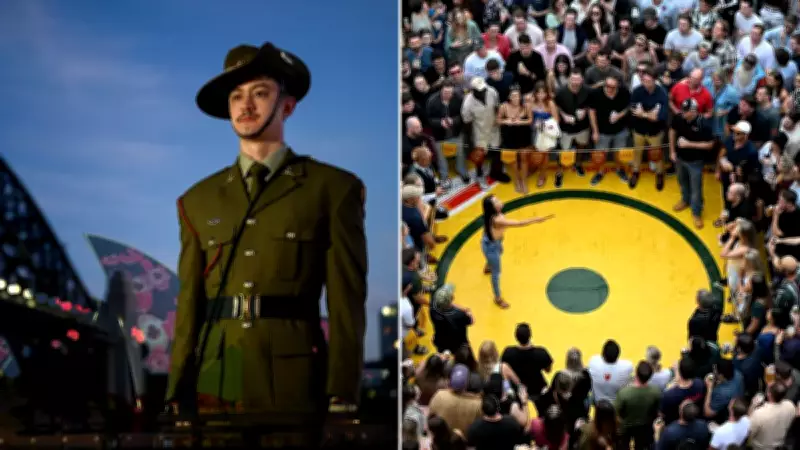
Two-up is a traditional game closely linked to Anzac Day, with roots dating back to World War I. While its exact origins are unclear, early versions are believed to have evolved from older English and Irish gambling games brought to Australia during the convict era. It later became widely played by Australian soldiers during the war. For Diggers serving overseas, two-up was a simple way to pass the time and relieve boredom. It required little equipment and could be played almost anywhere, quickly becoming a popular pastime in the trenches.
When soldiers returned home, they brought the game with them. It began appearing in pubs and Returned and Services League (RSL) clubs, where veterans gathered to socialise and reconnect. The game itself is straightforward. Two coins are placed on a small paddle, known as a “kip”, and tossed into the air by a player called the spinner. Players bet on whether the coins will land as two heads or two tails. Although two-up has long been considered an unregulated form of gambling, authorities often turned a blind eye during wartime due to its popularity. Today, it is generally illegal in Australia, but exceptions are made on Anzac Day and other commemorative occasions in some states.
Anzac biscuits
Anzac biscuits have been part of Australian life for more than a century, with a history that stretches back to World War I. The biscuits became popular when families began sending them to troops serving overseas. Packed into tins, they were included in care packages by wives, mothers and girlfriends concerned about the food being supplied on the frontlines. Their biggest advantage was how well they travelled. Made from simple ingredients, they could last the long journey by sea and still be edible months later.
Early versions were quite different from what we know today. Often called “soldiers’ biscuits” or “army biscuits”, they were harder and more basic, sometimes eaten as a substitute for bread or crushed into a porridge. After the Gallipoli campaign, they became more closely associated with the Anzacs, eventually taking on the name still used today. Over time, ingredients like golden syrup, coconut and sugar were added, shaping the sweeter version now widely recognised. Today, Anzac biscuits are closely tied to remembrance, often baked around Anzac Day and Remembrance Day, and still sent to loved ones serving overseas. The name itself is protected under Australian law. To be sold as an Anzac biscuit, it must follow a generally accepted recipe and shape and cannot be labelled as a “cookie”.