World number one Aryna Sabalenka has issued a direct appeal to grand slam tournament organisers, calling for them to overturn their contentious prohibition on fitness tracking devices. The Belarusian champion made her plea after triumphing in sweltering conditions to secure her place in the Australian Open quarter-finals on Tuesday.
Victory Amidst Extreme Heat Conditions
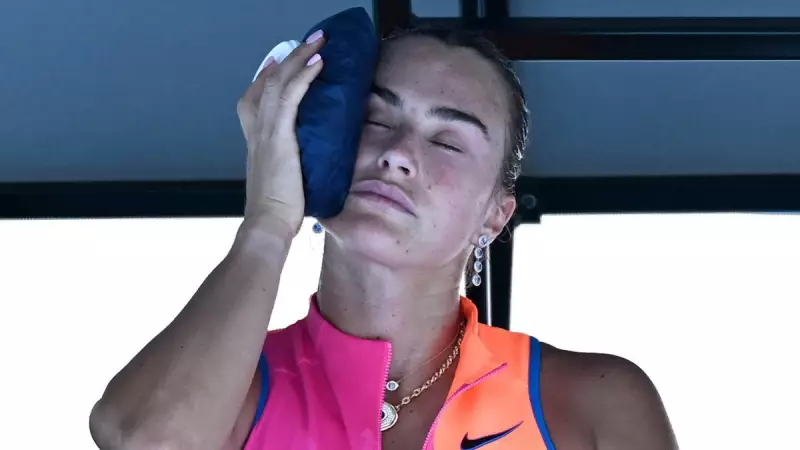
Sabalenka overcame both the searing heat and the challenge posed by American teenage prodigy Iva Jovic, winning decisively with a score of 6-3, 6-0. This victory made her the first player to advance to the quarter-finals of this year's tournament. Immediately following the match's conclusion, officials ordered the roof to be closed on Rod Laver Arena as temperatures approached a scorching 40 degrees Celsius, triggering the implementation of the Heat Stress Scale.
"I knew going into this match that they wouldn't let us play on in crazy heat," Sabalenka remarked. "If the Heat Stress Scale reached level five, they would definitely close the roof, so I understood they were protecting our health. When we finished, it was at 4.4, so it was quite intense. I'm simply happy that I managed to perform under those conditions."

The Controversial Fitness Tracker Ban
Earlier in the tournament, Sabalenka, along with men's world number one Carlos Alcaraz and other competitors, were instructed to remove their fitness tracking bands, which are typically worn on the wrist. This directive has sparked significant debate within the tennis community.
"The reason I was wearing that device on court is because we received an email stating we had approval from the International Tennis Federation to use it," Sabalenka explained. "I was unaware that the grand slams had not reached the same conclusion. I genuinely don't understand their reasoning, as we wear Whoop devices throughout the entire year during WTA tournaments and all other competitions I participate in."
Sabalenka emphasised that the trackers serve a purely health-monitoring purpose, stating, "It's solely for tracking my health metrics. I don't comprehend why the grand slams are prohibiting us from wearing them, and I sincerely hope they will reconsider this decision and allow players to monitor their health effectively."
Continuing Dominance at Melbourne Park
The victory over Jovic, who was contesting her maiden grand slam quarter-final, moves Sabalenka within one win of achieving her fourth consecutive Australian Open final appearance. The reigning champion, who lifted the trophy in both 2023 and 2024 before losing last year's title match to American Madison Keys, has demonstrated remarkable consistency.
As a four-time major champion, Sabalenka has now won an impressive 25 of her last 26 matches at Melbourne Park. Her next challenge will be a semi-final clash on Thursday against either US third seed Coco Gauff or twelfth seed Elina Svitolina from Ukraine. Notably, Sabalenka also defeated another rising teenage star, Canada's Victoria Mboko, in the round of sixteen.
Praising Her Young Opponent
"That's two teenagers who have tested me in the last couple of rounds," Sabalenka acknowledged, having yet to drop a single set in her five matches at this year's Australian Open. "Jovic is an incredible player, and it was a tough match. Don't be misled by the scoreline because it wasn't easy at all. She played some truly exceptional tennis."
The 29th-seeded Jovic was the lowest-ranked player, male or female, to reach the quarter-finals at Melbourne Park in a tournament that has largely followed expectations during its opening ten days. She became the youngest woman to reach the Australian Open quarter-finals since Nicole Vaidosova in 2007 and the youngest to achieve this feat without dropping a set since Venus Williams in 1998.
Before ascending to the senior ranks, Jovic had already established an impressive junior career, winning the prestigious Orange Bowl junior tournament and securing girls' doubles titles at both the Australian Open and Wimbledon.