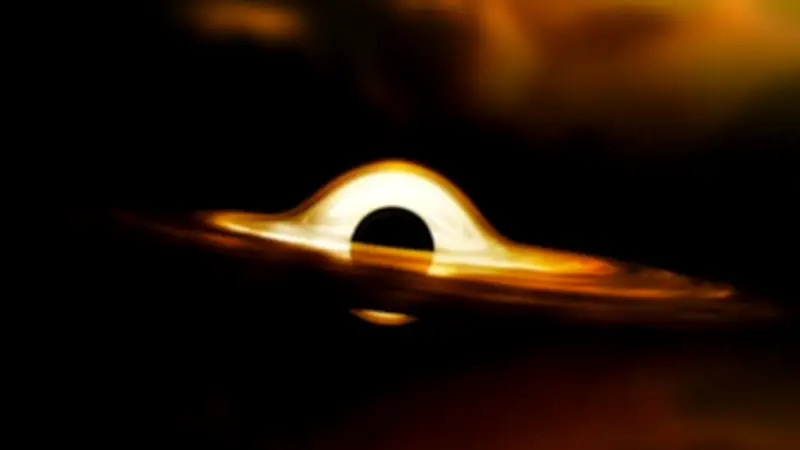
A groundbreaking detection of a 'direct wave' from the most powerful black hole merger ever recorded has unveiled a subtle signature of how rotating black holes drag spacetime itself into a whirlpool around them. The discovery, published today in Nature, offers an unprecedented view of the region just outside a black hole's event horizon.
The Loudest Merger on Record
Last year, scientists detected the cataclysmic merger known as GW250114, the 'loudest' black hole collision event ever observed. When two black holes spiral together and merge, they unleash gravitational waves—ripples in the fabric of spacetime that stretch and squeeze space as they travel across the universe. These waves are captured by detectors like the Laser Interferometer Gravitational Wave Observatory (LIGO) in the United States. The event GW250114 was so powerful that it allowed researchers to decode a previously hidden component of the signal: the direct wave.
What Is Frame Dragging?
According to Einstein's theory of general relativity, a rotating black hole does not sit passively in space. Instead, it produces an effect called frame dragging, where the spacetime around the black hole is twisted and dragged along with its rotation. Close to the event horizon—the boundary beyond which nothing, not even light, can escape—this effect becomes so extreme that nothing can remain still. As the lead author explained, 'It's like a whirlpool: anything drifting too close is forced to turn with the water. Around a spinning black hole, it is not water being dragged around, but spacetime itself.'

Detecting the Direct Wave
The direct wave is gravitational radiation that originates from immediately outside the event horizon, where infalling matter experiences frame dragging. Although the existence of this wave was predicted by theory, it had never been detected until now. The researchers developed new techniques to carefully separate this faint signal from the louder gravitational waves produced by the two original black holes spiraling inward before the merger. The direct wave reveals two key properties of the newly formed black hole: its spin rate and the strength of gravity at its event horizon.
A Window into the Unknown
This detection opens a new window for studying black holes and testing the limits of general relativity. For decades, the event horizon has been a central concept in theoretical physics, but direct information from near the horizon has been elusive. Light cannot escape from this region, so gravitational waves provide the only means of observation. The direct wave brings scientists closer than ever to the event horizon itself. 'Detecting the direct wave opens up a new source of information about black holes and their event horizons,' the researchers noted.
Testing Einstein's Theory
The findings also pave the way for future tests of general relativity. If Einstein's theory holds, the properties of the direct wave, the horizon's rotation, and the surface gravity should all align in a precise manner. Any deviation could signal a crack in our current understanding of physics. Black holes sit at the boundary between general relativity, which describes gravity on large scales, and quantum mechanics, which governs the smallest particles. These two theories are both highly successful—underpinning technologies like GPS, semiconductors, and quantum computers—yet they remain fundamentally incompatible. Near the event horizon, where gravity is extreme, scientists hope to find clues that could lead to a deeper, unified theory.
Implications for Astrophysics
The successful detection of the direct wave from GW250114 marks a significant milestone in gravitational wave astronomy. It demonstrates that even subtle components of gravitational wave signals can be extracted with advanced analysis techniques, providing richer information about black hole mergers. As more mergers are detected, scientists will be able to study frame dragging and event horizon properties across a population of black holes, potentially revealing new physics beyond general relativity.