

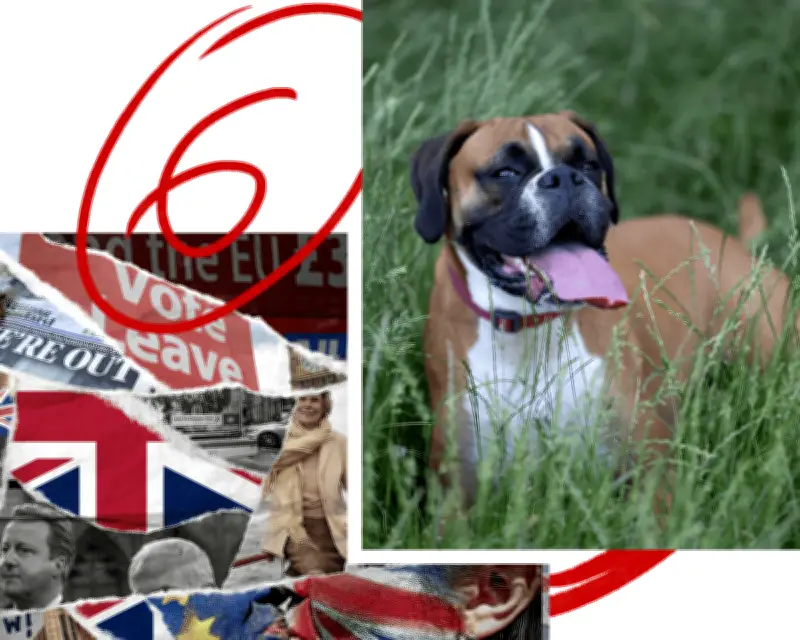
The art of dog training, often dismissed as a niche pursuit, has unexpectedly shed light on two of Europe's most pressing issues: the strategic missteps of the Brexit campaign and France's struggle with poorly insulated homes that turn into heat traps during summer.
Lessons from the Lead: Canine Behavior and Political Campaigns
According to renowned dog trainer Sarah Whitehead, the principles of positive reinforcement and clear communication are not just for pets but are equally applicable to political messaging. "The Brexit campaign failed because it ignored the basic rule of training: you must reward desired behavior, not just punish the opposition," Whitehead explained. She drew parallels between a dog's confusion when given mixed signals and the British public's bewilderment over contradictory claims during the 2016 referendum.
Whitehead noted that the Leave campaign's reliance on fear and vague promises mirrored a training technique that relies on intimidation, which rarely yields long-term compliance. "In dog training, we know that punishment creates anxiety and rebellion, not cooperation. The same happened with Brexit—voters felt coerced, and the result was a divided nation."

France's Heat Trap Homes: A Structural Crisis
Meanwhile, France faces a different kind of crisis: its aging housing stock, often called "passoires thermiques" (thermal sieves), traps heat during summer, endangering vulnerable populations. A 2025 report from the French Environment and Energy Management Agency (ADEME) revealed that over 7 million homes are poorly insulated, leading to indoor temperatures exceeding 40°C during heatwaves. This is a 15% increase from 2020, highlighting the urgency of renovation.
Whitehead, who also advocates for sustainable living, sees a connection: "Just as a dog needs a comfortable environment to thrive, humans need homes that protect them from extreme weather. France's heat trap homes are a failure of design and policy, much like the Brexit campaign was a failure of communication."
The Intersection of Training and Policy
The parallels extend beyond metaphor. Whitehead argues that the same principles of clear, consistent messaging and positive reinforcement could transform both political campaigns and energy efficiency programs. "If the French government wants homeowners to insulate their houses, they need to reward them with subsidies and clear guidance, not just threaten fines. It's basic training 101."
This approach is gaining traction. In 2026, the French government launched a €4 billion renovation plan, offering grants of up to €20,000 per household. Early results show a 30% increase in applications compared to the previous year, suggesting that incentives work better than penalties.
Brexit's Lingering Lessons
As Britain continues to grapple with post-Brexit realities, Whitehead's insights offer a retrospective critique. "The campaign focused on what people would lose, not what they would gain. In dog training, we call that a 'punishment-based approach.' It might work in the short term, but it destroys trust." She points to the ongoing trade friction and political instability as consequences of that initial mistrust.
Political analyst Dr. James Hargreaves of the University of Oxford agrees: "The Brexit campaign was a masterclass in what not to do. Clear, positive messaging could have united the country, but instead we got division."
Practical Solutions for France
For France, the solution is less about messaging and more about action. The ADEME report recommends mandatory energy audits for all homes sold or rented, coupled with low-interest loans for renovations. "We need to make it easy and rewarding for people to upgrade their homes," said ADEME director Marie Dupont. "Otherwise, the heatwave deaths will continue to rise."
Whitehead, who has trained dogs for over 30 years, sees her work as a universal lesson: "Whether you're training a dog, running a political campaign, or fixing a house, the key is clear communication and positive motivation. Ignore that, and you'll end up with chaos."