Impact heating dominated early Earth's energy budget
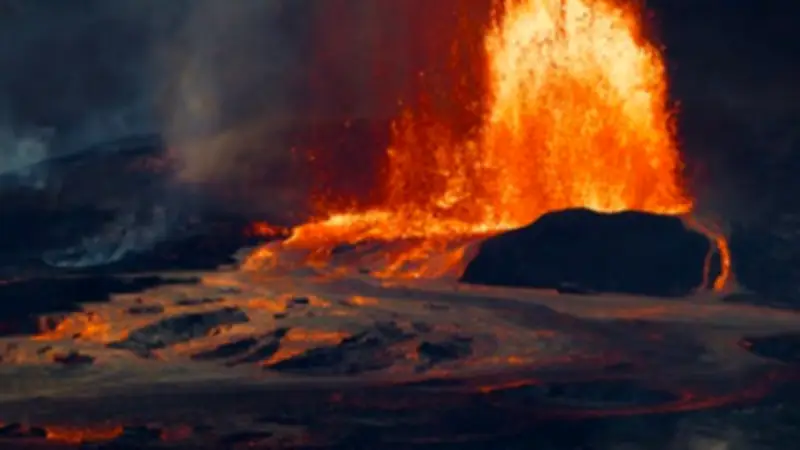
New research argues that the long-lived effect of impact heating has been greatly underappreciated in models of the Hadean eon – the first half-billion years of Earth's history. Rather than acting as brief interruptions to a planet cooling from within, repeated impacts kept the surface, or protocrust, of the young Earth hot, weak and geologically unstable for a very long time.
In their study, the researchers show that impact heat was not merely a minor addition to Earth's internal energy budget. Through most of the Hadean, impact heating appears to have vastly outweighed heat produced inside Earth itself.
Impacts drove mantle melting and volcanism
By adding heat and thinning or obliterating the crust, large impacts would have caused melting of the mantle beneath the impact site, generating large volumes of basaltic magma. Heat transferred into the mantle from the biggest impacts likely influenced volcanism and tectonic behaviour for tens to hundreds of millions of years.

According to the study, the effect was not limited to warming the rocks at the surface. The energy carried by these space rocks was transferred deep into the planet itself.
Early Earth looked very different from today
Some researchers have argued the early Earth may have been more similar to the modern Earth than we once thought, perhaps even capable of plate tectonics. However, the new results point in a different direction. If impacts were adding this much heat to the system, the early crust was likely thin, weak and partly molten below shallow depths.
That doesn't look much like the modern Earth. It looks more like a planet whose outer shell was being repeatedly renewed.
How continents emerged from a hot beginning
Large impacts would have fractured the young crust and helped water circulate through it for long periods, altering rocks near the surface. At the same time, melting of mantle beneath impact sites would have supplied huge volumes of magma to and through the crust. As these processes repeated, the surface ended up being composed of more silica, which is what we see in the pale-coloured rocks that characterise continental crust.
That may also help explain why the Hadean rock record is so sparse. If the crust was repeatedly heated, melted and recycled, much of Earth's earliest crust may simply not have survived.
What changed 3.9 billion years ago
It's apparent from studies that have analysed the impact history of the Moon that, by around 3.9 billion years ago, the global effect of impact heating in the inner Solar System had become much less important. That is also around the time Earth began to preserve large tracts of continental crust.
That timing seems unlikely to be a coincidence. Once the bombardment eased, the crust would have had a chance to cool, solidify and thicken. Only then may long-lived continents have become possible.
"All this means repeated impacts may have limited when Earth could begin to preserve a more lasting crustal record," the researchers said. "Our study does not end the debate about the Hadean. But it does suggest that any realistic picture of the early Earth has to take impacts, and impact heating, seriously."
If that is right, then the young Earth was not just scarred by impacts. It was reshaped by them, and the first continents may only have endured once the violence began to fade.