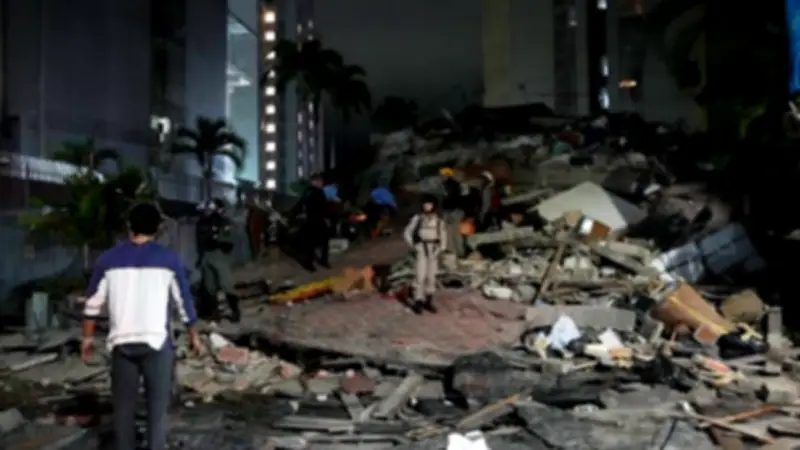
On Wednesday evening just after 6pm local time, two powerful earthquakes struck northern Venezuela in rapid succession, causing widespread devastation and raising the death toll into the thousands. The first quake, a magnitude 7.2 event, hit near San Felipe, the capital of Yaracuy state. Just 39 seconds later, a second earthquake of magnitude 7.5 struck near the town of Yumare, within 5 to 10 kilometres of the first epicentre. The US Geological Survey (USGS) classified the sequence as an earthquake doublet.
What is an earthquake doublet?
An earthquake doublet is a pair of earthquakes that occur within a short time and distance of each other. Unlike a typical sequence where a large earthquake is followed by much smaller aftershocks, doublets consist of earthquakes of similar magnitude that are causally linked but seismologically distinct. In this case, the USGS data suggests the two quakes likely originated from different faults with different rupture styles. The region's active faults include large strike-slip faults oriented east-west, linked with arrays of smaller faults in various orientations. It is probable that the first earthquake triggered the second by increasing stress on the second fault or by passing seismic waves that rattled a nearby fault already prone to rupture.
Impact and damage
Powerful ground shaking was felt across a wide area, including Venezuela's capital Caracas, located about 150 kilometres east of the epicentres. The shaking caused buildings to collapse, and authorities report that the casualty toll may be in the thousands. In addition to structural damage, ground failure including landslides and liquefaction are anticipated throughout the region. The earthquakes struck in a mountainous area where slope failures are common, and the sediment beneath Caracas amplifies seismic waves, enhancing earthquake damage.

Why is Venezuela prone to earthquakes?
Venezuela lies on the diffuse onshore boundary between the Caribbean and South American tectonic plates. In northern Venezuela, these plates slide past each other at a rate of about 20 millimetres per year as the Caribbean Plate moves east relative to the South American Plate. This produces large strike-slip faults, including the Boconó, San Sebastián, and El Pilar fault systems. This active plate boundary generates frequent shallow earthquakes, some of which can be damaging. The region has experienced several significant earthquakes in the past, such as the magnitude 7.7 Caracas earthquake in 1900 and a magnitude 6.5 earthquake in 1967. West of the recent earthquake, the plate boundary becomes broader and more complex, prone to widespread seismic activity with many shallow to intermediate-depth earthquakes.
Historical context
Earthquake doublets are uncommon but have occurred elsewhere. In 2023, a doublet struck Turkey and Syria with magnitudes of 7.8 and 7.7, occurring 95 kilometres and nine hours apart, affecting 14 million people. In 1988, a triplet—three earthquakes within half an hour—occurred in Tennant Creek, Australia.