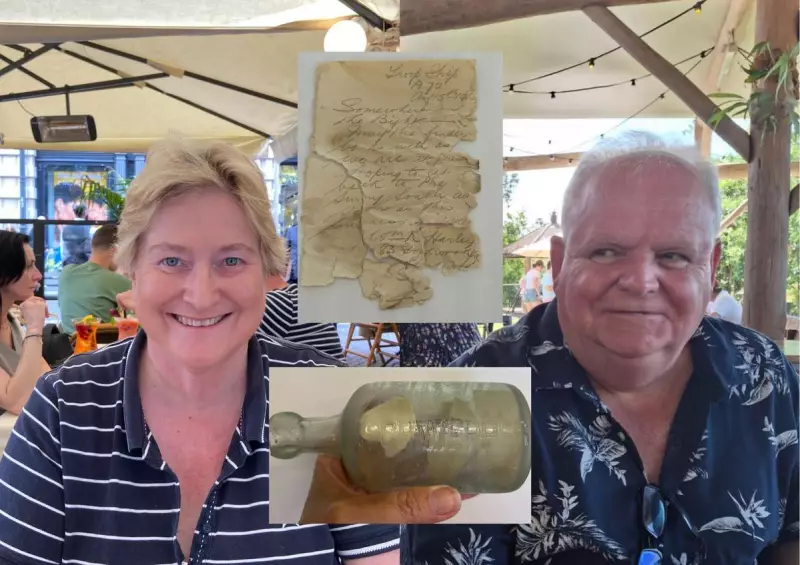
In an extraordinary twist of fate, a 109-year-old message in a bottle has washed ashore on a Western Australian beach, bridging a century to connect the descendants of two World War I soldiers with their ancestors' poignant words.
A Century-Old Discovery on Wharton Beach
The remarkable story began in October last year when a local Esperance family made an unexpected find on the sands of Wharton Beach. They discovered an old glass bottle containing several letters, carefully dated August 15, 1916. The messages were written by two Australian soldiers, Malcolm Alexander Neville, 27, and William Kirk Harley, 37, as they sailed towards the battlefields of France.
Private Neville had penned two notes. One was a cheerful message to his mother, stating he was having a "real good time", while the other was addressed to the future finder of the bottle and included his mother's address in Wilkawatt, east of Adelaide. Tragically, Neville was killed in action just eight months later on April 11, 1917.

William Harley's letter was also directed to the discoverer, bearing the hopeful wish, "may the finder be as well as we are". Historical records suggest Harley survived the war but later succumbed to war-related injuries at the age of 55.
Goosebumps and Generational Reunions
Determined to return the historic documents, local researcher Deb Brown embarked on a detailed online search. Her efforts successfully located the soldiers' families: Mr Neville's great-nephew, Herbie Neville, and Mr Harley's granddaughter, Ann Turner.
For Ann Turner's family in Adelaide, receiving her grandfather's letter was a profound and eerie experience. She described it as a "goosebump moment," noting the uncanny similarity between her grandfather's handwriting and that of her mother, who was only nine when he died.
"As soon as we saw the letter we knew it was definitely our relative," Ms Turner said. The discovery has sparked a wave of renewed family connection and historical research, uncovering long-lost relatives and details about Harley's pre-war life as a pattern-maker at his family's foundry in Goodwood, South Australia.
"I really did feel our grandfather had reached out from the grave and he's just created this closeness with the family," she reflected.
Herbie Neville, equally moved, was astounded by the letter's pristine condition after over a century in the ocean. "It was like he'd just written it the other day," he remarked, expressing a desire to visit Esperance to see where the bottle made landfall.
A Permanent Home for a National Treasure
Now united with their family legacies, both descendants agree the fragile letters belong in a permanent, publicly accessible home where they can be preserved and shared. The families are considering institutions like the Australian War Memorial in Canberra or local museums in the soldiers' home states.
Ms Turner advocates for a national repository, emphasising the story's significance to all Australians. "Private Neville was from Victoria and the fact it's found in Western Australia; it would be better for it to be at a national place," she said. "We really want it properly preserved... because it's an extraordinary piece of World War I history."
The families plan to make a final decision on the letters' permanent resting place in late January or early February, ensuring this poignant message from the past continues to resonate for generations to come.