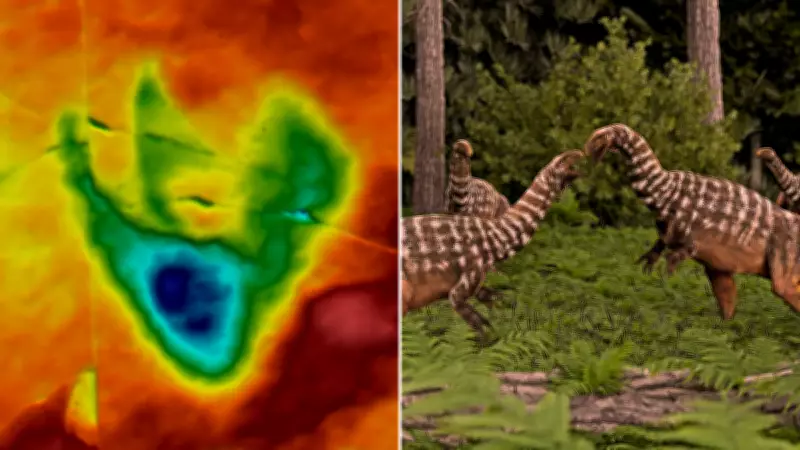
A remarkable dinosaur fossil discovered in Brisbane has been officially confirmed as the oldest fossil ever found in Australia, dating back an astonishing 230 million years. This fossilised footprint, unearthed in the suburb of Albion, represents the only dinosaur fossil ever discovered within an Australian capital city, making it a landmark find for the nation's palaeontological history.
The Childhood Discovery That Made History
The journey to this groundbreaking discovery began over six decades ago, when a young palaeontologist named Bruce Runnegar, then just a child, visited a sandstone quarry in Albion. Runnegar and his friends were initially searching for plant fossils when they stumbled upon strange markings embedded in the rocks. Intrigued by the unusual patterns, the budding scientist used a chisel to carefully extract what he believed to be a dinosaur footprint, adding it to his personal collection after showing it to a local museum.
"At the time, we suspected the marks might be dinosaur tracks, but we couldn't have imagined their national significance," Runnegar recalled. This initial find would later become the cornerstone of a major scientific revelation, though its true importance remained hidden for decades.

A Fossil's Journey Across the Globe
Runnegar went on to pursue a Bachelor of Science and PhD at the University of Queensland, eventually teaching palaeontology at the University of New England in Armidale before relocating to Los Angeles to teach at the University of California. Throughout his academic career, he used the Brisbane fossil as a teaching tool, with the footprint spending nearly forty years in the United States before he finally brought it back home to Australia.
"It was a great example of a special kind of trace fossil because the footprint was made in sediment by a heavy animal," Runnegar explained. Despite its educational value, the fossil remained formally undocumented until Runnegar decided to reach out to Dr Anthony Romilio from the University of Queensland's Dinosaur Lab, known for his expertise in reconstructing, analysing, and mapping dinosaur footprints.
Unlocking the Secrets of Australia's Prehistoric Past
Dr Anthony Romilio revealed that the 18.5-centimetre footprint had remained unstudied for more than sixty years. His analysis has now proven that dinosaurs were present in Australia much earlier than previously recognised, fundamentally altering our understanding of the continent's ancient ecosystems.
"This is the only dinosaur fossil to be found in an Australian capital city and shows how globally significant discoveries can remain hidden in plain sight," Romilio stated. He described how the dinosaur likely walked through or alongside a waterway, leaving the imprint that was later preserved in sandstone. This sandstone was eventually quarried millions of years later to construct buildings across Brisbane, highlighting the deep historical layers embedded in the city's urban landscape.
Without the foresight to preserve this material, Brisbane's dinosaur history would still be completely unknown, Romilio emphasised, noting that urban development has since made the original quarry site inaccessible, leaving this footprint as the sole surviving dinosaur evidence from the area.
The Dinosaur Behind the Footprint
Romilio identified the footprint as belonging to a small, two-legged dinosaur, likely a sauropodomorph—an early relative of long-necked dinosaurs like the brontosaurus. This creature lived during the Triassic period, a time when dinosaurs were first beginning to dominate the planet. Based on the footprint's size, researchers estimate the animal stood approximately 75 to 80 centimetres tall at the hip and weighed around 140 kilograms.
"More than 60 years after we found it, it's extraordinary to see it recognised as Australia's oldest dinosaur fossil," Runnegar reflected, expressing his awe at the fossil's newfound significance. The fossil is now housed at the Queensland Museum, where it will be available for ongoing research, ensuring that this incredible piece of Australia's natural heritage continues to inspire and educate future generations.