East Perth Cemeteries: A Silent Chronicle of Western Australia's Colonial Beginnings
The East Perth Cemeteries stand as a profound historical landmark, quietly narrating the untold stories of Western Australia's colonial past. Nestled on what was once known as Cemetery Hill, this site holds the remains of prominent citizens, captains of industry, and ordinary people from the Swan River Colony's infancy.
A Landscape of Memory and Loss
Some gravestones reach skyward with heartfelt tributes, while others hug the earth unobtrusively. Many have weathered time well, engraved with names, dates, and fond farewells that keep memories alive. Others have been defeated by the elements, their messages obscured, faded, or completely lost. Oyster shells crunch underfoot, remnants of old garden paths, as modern apartments loom beyond the fences. Despite the city's buzz nearby, a sense of calm and peace pervades this hilltop sanctuary.
The cemeteries, now under the care of the National Trust of WA, span about 5 hectares—a much smaller area than originally, as sections have been carved out over the years. This site is a remnant of seven independently owned cemeteries covering various religious denominations and cultural groups.

Early Beginnings and Colonial Governance
The first part of the cemetery was assigned on December 9, 1829, surveyed by John Septimus Roe. Governor James Stirling issued a notice on February 13, 1830, to prevent indiscriminate burials, emphasizing the need for registered interments. The first acknowledged burial was John Mitchell, a soldier, on January 6, 1830, though his headstone is lost. The earliest known location is Louisa Jones, buried on December 24, 1830, with her headstone updated when her husband joined her in 1876.
Initially non-denominational, the burial ground was granted to Church of England trustees in 1842. Over time, cemeteries for other groups were allocated: Roman Catholic in 1848, Independent Congregational and Wesleyan Methodist in 1854, Jewish in 1867, Presbyterian in 1881, and Chinese in 1888. A cemetery for felons was assigned in 1867.
Architectural and Social Evolution
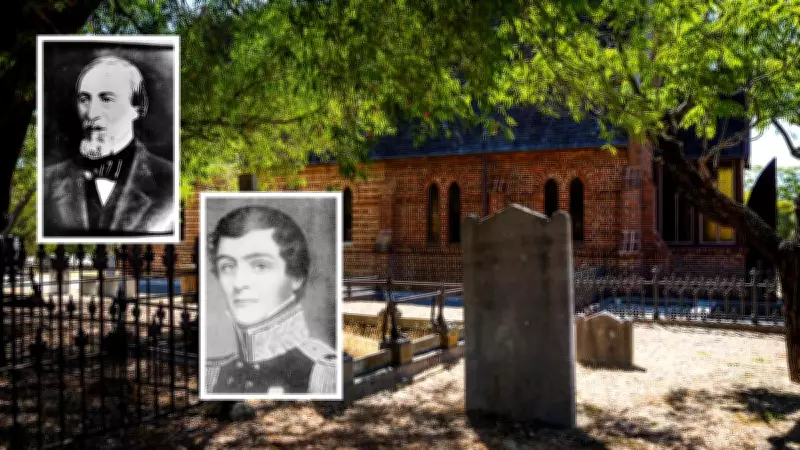
A Gothic church, St Bartholomew's, designed by colonial architect Richard Roach Jewell, was built in 1871 and expanded in 1900. The gold rush of the 1890s increased burials, with funerals often involving a difficult trek up Cemetery Road. As Perth grew, concerns about health hazards led to criticism, culminating in the cemetery's closure in 1899, with Karrakatta Cemetery becoming Perth's main burial ground in 1900.
Neglect and vandalism plagued the site through the 1920s and 1930s. In 1932, it was declared disused, and in the late 1940s, damaged headstones were removed. Preservation efforts gained momentum in the 1950s, leading to the National Trust taking over St Bartholomew's Church in 1975 and the rest of the site in 1994.
Demographics and Notable Burials
Research has identified over 9,100 burials: 64% male, 36% female, and 53 of unknown sex. The average age at death was 29 years and 10 months, with 32% infants, 6.7% children aged 18 months to 12 years, and about 55% adults. Notable figures include John Septimus Roe, surveyor and founder; Richard Roach Jewell, colonial architect; George Leake, premier and Federation advocate; and Tommy Dower, the only confirmed Aboriginal burial. Governor Andrew Clarke and convict Henry Feast also rest here, reflecting the social spectrum.
Many names, such as Leeder, Padbury, and Monger, are echoed in WA suburbs and streets. Tragedies are evident, like the headstone for Robert Mace Wittenoom, who drowned at age 10, inscribed with "Cut off like a flower in bud."
Preservation and Legacy
National Trust chief executive Alan Barrett emphasizes the site's significance as Martellup to the Whadjuk people, telling the early story of the colony. "Preserving this place allows us to honour those lives and reflect on the social history embedded in the landscape," he says. Volunteers open the cemeteries to visitors each Sunday and host school tours, ensuring these stories endure for future generations.