

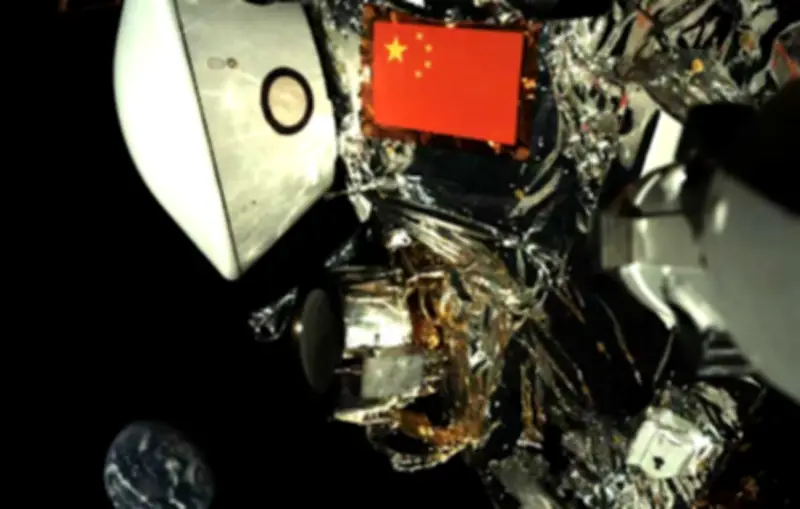
China's Tianwen-2 spacecraft is poised to begin science operations around the intriguing asteroid 469219 Kamo'oalewa in early July 2026, aiming to solve the mystery of whether this quasi-satellite is a piece of the Moon or a common stony asteroid altered by space weathering.
Mission Overview
Launched in May 2025 by the China National Space Administration, Tianwen-2 is an ambitious sample-return mission targeting Kamo'oalewa, a quasi-satellite that orbits the Sun in near lockstep with Earth. The asteroid, measuring between 30 and 60 metres across, rotates once every 28 minutes, posing challenges for sample collection. After a series of manoeuvres, including a main burn on 7 June 2026, the spacecraft is now believed to be in orbit around the asteroid, with science operations expected to commence in the first week of July.
The Mystery of Kamo'oalewa
Kamo'oalewa, whose name means "oscillating celestial object" in Hawaiian, was discovered in 2016 and initially thought to be a lunar fragment based on its light reflection properties. However, more recent analyses suggest it could be an LL chondrite, a common type of stony asteroid, whose surface has been severely weathered by space exposure. The debate has persisted because Earth-based telescopes can only study the asteroid's surface, which may be misleading due to space weathering.

According to Dr. Jane Smith, an astronomer at the University of Sydney, "The only way to settle this debate is to analyse samples from below the surface, which Tianwen-2 is designed to do."
Quasi-Satellites Explained
Quasi-satellites like Kamo'oalewa are not true moons; they remain gravitationally bound to the Sun but appear to orbit Earth from our perspective. Kamo'oalewa entered its current quasi-satellite orbit about 100 years ago, and at its closest approach on 27 December 1923, it was 12.44 million kilometres from Earth. By late May 2369, it will reach a distance twice the Sun-Earth separation.
Sample Collection Strategy
Tianwen-2 will attempt multiple sampling methods: hovering to suck up loose dust, touching down for a larger rock sample, and firing robotic extensions into subsurface layers. This strategy aims to retrieve pristine material unaffected by space weathering. Previous missions like Hayabusa-2 and OSIRIS-REx have demonstrated the value of sample returns, revealing unexpected details about their target asteroids.
Scientific Importance
The returned samples will be analysed in laboratories on Earth to determine mineral compositions and isotopic signatures. If Kamo'oalewa is a lunar fragment, it could provide insights into the Moon's history. If it is a weathered asteroid, it will help scientists understand space weathering processes. Either outcome will be valuable for understanding the evolution of the Earth-Moon system and the early inner Solar System.