
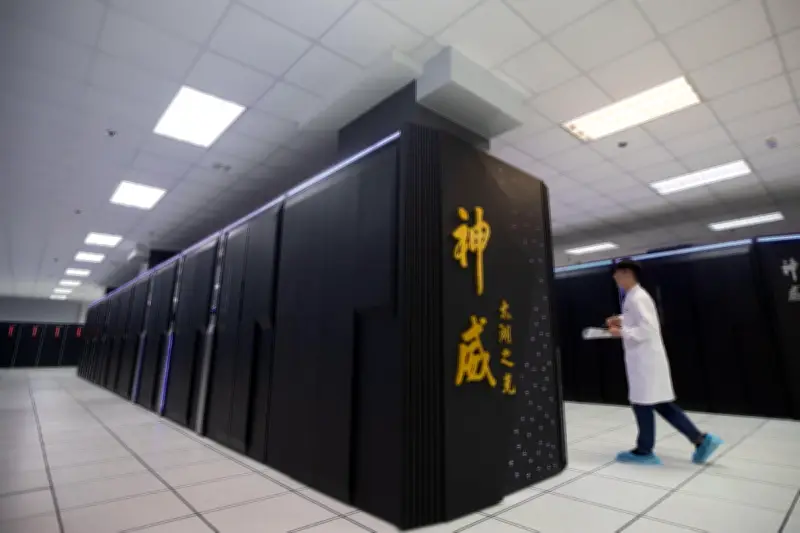
China's LineShine supercomputer has claimed the top spot in the latest Top500 rankings, surpassing the best US machines and marking the first time since 2017 that a Chinese computer has led the list. The rankings, released on Tuesday, position LineShine as the world's most powerful supercomputer, a distinction often viewed as a measure of national technological prowess.
LineShine's Debut and Specifications
LineShine, located at the National Supercomputing Center in Shenzhen, debuted at number one, displacing the previously top-ranked US computer El Capitan. Unlike many high-performance computers that rely on graphics processors (GPUs) for AI tasks, LineShine operates entirely on conventional computer chips (CPUs). It requires approximately 42.2 megawatts of electricity to run, according to the Top500 list.
Performance Metrics
Scientists involved in the Top500 project reported that LineShine achieved 2.198 exaflops, meaning it can perform over 2 quintillion calculations per second. This performance places it ahead of El Capitan at the US government's Lawrence Livermore National Laboratory in California, which now ranks second. Two other US supercomputers at national laboratories in Tennessee and Illinois follow in third and fourth places.

Global Rankings and Exascale Computers
Dropping to fifth place is the Jupiter supercomputer in Germany. These five machines are the only publicly verified exascale computers in the world. Other countries with systems in the top 10 include Italy, Switzerland, and Japan. The UK has 11 machines in the list of 500, with the University of Bristol's Isambard-AI ranked 11th, down two places from the previous ranking. Isambard-AI is equipped with 5,400 Nvidia superchips and housed in a black metal cage topped with razor wire. Western Australia's Setonix, ranked 86th, is the best performing of the four machines located in Australia.
EU's AI Gigafactories Plan
Last year, the EU unveiled a €20 billion plan to build sites equipped with vast supercomputers to develop the next generation of AI models, as Europe attempts to catch leaders in the US and China. The AI gigafactories will target moonshot innovations in areas such as healthcare, biotech, industry, robotics, and scientific discovery. According to the EU strategy document, the best-performing AI factories have supercomputers with up to 25,000 advanced AI processors, but a gigafactory would exceed 100,000 AI processors. These power-hungry facilities, which can require huge amounts of water for cooling, should run as much as possible on a green energy supply, an EU official said, with plans for recycling water if used. Campaigners fear that power-hungry datacentres could undermine Europe's climate ambitions.