Middle East Conflict Escalates into Second Month with Global Repercussions
The ongoing war in the Middle East has now entered its second month, with the conflict dramatically spreading to Europe and escalating across the entire region. This follows devastating air strikes conducted by the United States and Israel against Iran, which resulted in the death of Ayatollah Ali Khamenei along with several senior Iranian leaders.
Operation Epic Fury Sends Shockwaves Through Global Markets
The military campaign, officially dubbed Operation Epic Fury, has sent profound shockwaves through multiple critical sectors worldwide. From international shipping and air travel to the volatile oil industry, the repercussions are being felt acutely. Energy costs are soaring rapidly, while business operations face severe disruption in the strategic Strait of Hormuz, a vital global trade hub that handles a significant portion of the world's oil shipments.
Iran Shuts the Strait of Hormuz Over Ceasefire Violations
In a major development, Iran has once again closed the Strait of Hormuz in response to what it claims are Israeli attacks on Lebanon. This action comes despite a temporary, two-week ceasefire agreement that was struck between the United States and Iran just the day before. The opening of this crucial shipping route to US-Israeli allies was a key component of the initial negotiations for the ceasefire.

While Israel publicly acknowledged and stated it would follow the ceasefire agreement with Iran, it explicitly declared it would continue its military conflict with Hezbollah, the Lebanon-based militia group. Following this declaration, Israel launched what it described as its "largest strike" against Lebanon since the war began on February 28.
Iranian Officials Condemn Ceasefire Violations
In response to these developments, Iranian officials have not only shut the Strait of Hormuz to US-Israeli allies but have also warned that the already delicate ceasefire agreement is now on very thin ice. Mohammad-Bagher Ghalibaf, Speaker for Iran's Parliament, stated that the attacks represented just one of three clauses in the 10-point deal that had been violated in less than a single day.
"The deep historical distrust we hold toward the United States stems from its repeated violations of all forms of commitments—a pattern that has regrettably been repeated once again," Ghalibaf asserted. He alleged that the attacks on Lebanon breached the clause calling for an "immediate ceasefire everywhere" and claimed that a drone had entered Iran's airspace. Ghalibaf further contended that Iran's "right to enrichment" had been denied, potentially alluding to the country's controversial nuclear programs.
"Now, the very 'workable basis on which to negotiate' has been openly and clearly violated, even before the negotiations began," he declared. "In such a situation, a bilateral ceasefire or negotiations is unreasonable."
Israel Launches Massive Strike on Lebanon's Capital
A devastating wave of Israeli attacks targeted the center of Lebanon's capital, Beirut, resulting in hundreds of casualties in less than a day after the US-Iran ceasefire deal was signed. The Israeli Defence Forces announced that the airstrikes conducted on Wednesday represented their "largest" military action since the conflict's inception.
Lebanese Civil Defence reported that 254 people had been killed in the attack, with an additional 1,165 individuals injured. Israeli Prime Minister Benjamin Netanyahu expressed his welcome for the ceasefire agreement between the US and Iran and affirmed that Israel would respect that particular deal. However, he emphasized that the ceasefire would not extend to Israel's ongoing conflict with Hezbollah.
"The IDF just carried out the largest strike against Hezbollah terrorists since the beginning of Operation Roaring Lion," the IDF stated regarding Wednesday's attacks. "In just one minute, the IDF struck 100 Hezbollah military targets in different locations across Lebanon." The Israeli military alleged that Hezbollah was using "civilians as human shields" and had "dragged Lebanon into this war," asserting, "We are fighting Hezbollah, not the people of Lebanon."

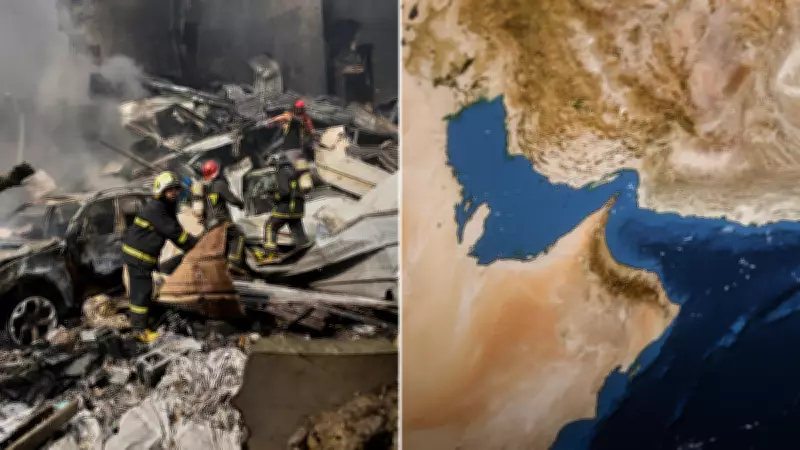
Images emerging from Lebanon depict a harrowing aftermath, with buildings reduced to rubble as emergency services work tirelessly to recover the wounded and the deceased. The humanitarian crisis continues to deepen as the conflict shows no signs of abating, with global economic and political stability hanging in the balance.