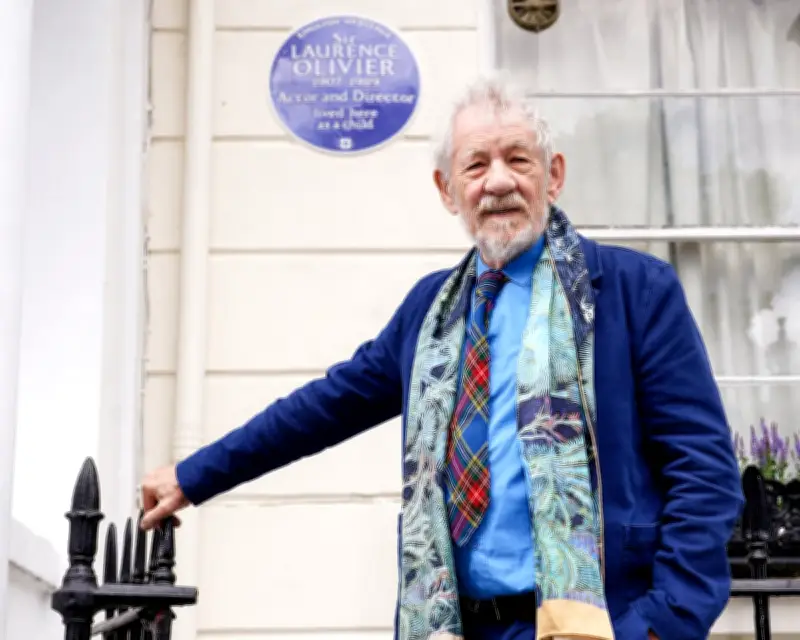
Laurence Olivier has joined David Garrick, Henry Irving, Oscar Wilde and Noël Coward in having an English Heritage blue plaque outside his former London home. Ian McKellen unveiled the plaque at 22 Lupus Street in Pimlico, where Olivier lived from the age of five to 12 and discovered a talent for acting under the watchful eye of his father, a curate at St Saviour’s church across the road.
David Hare once said that a blue plaque was the only honour worth having, but the trouble was that you never lived to see it. You felt, however, that Olivier would have been gratified by the warmth of the tributes paid on Wednesday afternoon.
McKellen said it was the fate of actors to be forgotten 20 years after their death, but that Olivier’s memory lived on in numerous ways, partly through having a theatre and an awards ceremony named after him but even more through the glow cast by his performances.

“I never had the luck to act with him but I was briefly part of his National Theatre company at the Old Vic and when I left he sent a message to my agent saying he was haunted by the spectre of lost opportunities,” he said. “When I did Macbeth at Stratford in 1976 for Trevor Nunn he also left a note saying it was the most achieved version of the play he had ever seen, which was very touching since I’d seen Olivier play Macbeth 20 years earlier.”
McKellen didn’t just laud Olivier. He gave us a touch of Larry in the afternoon by doing a rousing version of the “once more unto the breach” speech from Henry V that Olivier recorded as part of a campaign to save the Rose theatre and that ended with “Cry God for Harry, England and the Rose”.
Chatting to McKellen, shortly to depart for New Zealand to recreate his Gandalf, I realised that he and I were fortunate to have seen Olivier in our teens. Indeed we both recalled bits of business from his Stratford Malvolio.
Indhu Rubasingham, the National’s artistic director who made the opening speech at the ceremony, said she was several decades too young to have seen Olivier on stage but talked movingly of his courage and vision in creating a National Theatre company from scratch.
Strolling over the road afterwards to St Saviour’s, where the young Diana, Princess of Wales, worked as a kindergarten assistant, one also realised the profound impact the church had on the young Olivier. He was not only a choirboy but listened awestruck to sermons by his father and others.
“Those preachers,” he later recalled, “knew when to drop the voice, when to bellow about the perils of hellfire, when to slip in a gag, when to suddenly wax sentimental, when to turn solemn, when to pronounce the blessing.”
It is not altogether fanciful to imagine the boy Olivier learning in Pimlico the value of service which was to mark his whole career as an actor and director.