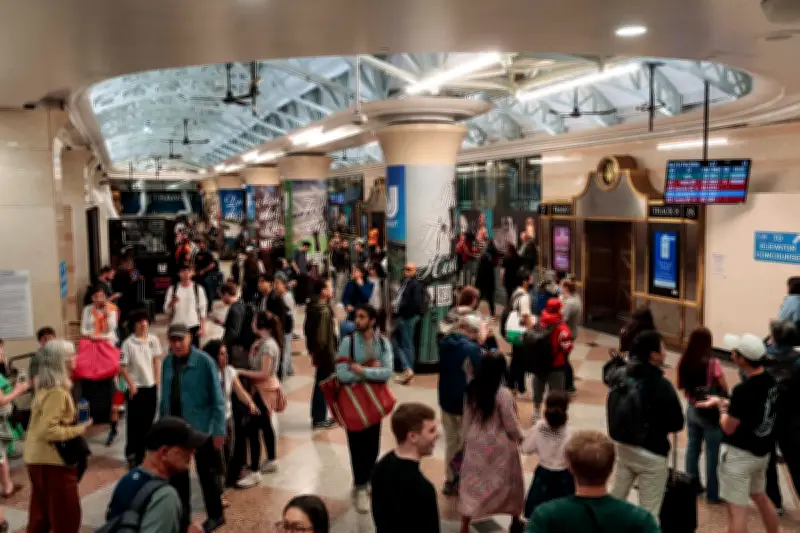
Travelers wait for New Jersey Transit trains at Penn Station in New York, US, on 22 May 2026. Photograph: Adam Gray/Bloomberg via Getty Images
Will Penn Station’s much-needed makeover boost commuters – or Trump? A proposed $8bn renovation of the hub has critics wondering if it’s another example of the US president bolstering his legacy at taxpayers’ expense.
A proposed $8bn renovation of Penn Station in New York City has sparked questions from local leaders who want improvements to the western hemisphere’s busiest transit hub but wonder what it will look like, who will pay for it and what role Donald Trump will play.

The station, which was once considered one of New York City’s most beautiful landmarks, is now seen by many as an ugly infrastructure that is hard to navigate, dark and claustrophobic. But as it faces a much-needed makeover, critics are asking: will this project focus on making commuting easier or primarily become another example of the US president trying to bolster his legacy at taxpayers’ expense?
“Too much emphasis has been given to more of the cosmetic issues of the station,” said Rachael Fauss, senior policy adviser for Reinvent Albany, a group that aims to increase government accountability in the state. “For us, the priority should be improving service and safety.”
The original Penn Station, which opened in 1910, was described as a beaux-arts masterpiece. “It boasted 84 granite Doric columns and its monumental architecture echoed the great spaces of Ancient Rome,” the New York Historical museum stated. But as more people started flying and driving rather than taking trains, its ridership decreased, and in 1963, it was demolished to make room for Madison Square Garden, the sports and entertainment arena.
Penn Station during the second world war, as soldiers were leaving to return to their posts after Christmas. Photograph: Bettmann/Bettmann Archive
Rail operations have since continued underground, and more than 600,000 people still travel through the station daily. While the public has long desired a renovation of the structure, efforts stalled because officials said it required moving the arena, something its owner, James Dolan, refused to do.
But on 8 June, the US Department of Transportation, Amtrak and Penn Transformation Partners, the chosen developers of the project, unveiled a plan that would leave Madison Square Garden intact. The overhaul would include building a grand entrance on Eighth Avenue, replacing “cramped, decrepit walkways with open, beautiful concourses”, and expanding train capacity, among other changes, according to the announcement.
“Our design not only creates more capacity and improves operations … it also will create – once again – a gateway to New York that is befitting our great city and will bring a sense of dignity to the experience of train travel to and from New York,” stated Vishaan Chakrabarti, founder of the Practice for Architecture and Urbanism and the lead design architect.
The construction, which planners said will begin by the end of 2027, would require tearing down a theater to make way for an art deco facade and the grand entrance, the announcement stated. The builders would also remove platform columns and construct new elevators, escalators and stairs to ease congestion and allow trains to more quickly enter and leave the station, according to the Practice for Architecture and Urbanism. The transformation would increase the train hall’s capacity by 165%, according to the firm.
“It really hits the right level of significant improvements to customers and their experience [and] significant benefits in terms of public safety,” said Tom Wright, president and CEO of the Regional Plan Association, an urban planning think tank.
Still, Wright and others have said there is an unanswered question: who pays for this? The transportation department’s announcement stated that funding would come primarily through federal grants to Amtrak, federal loans, private financing and equity raised by Penn Transportation Partners. But payment for those loans could ultimately come from New York City tax revenue, Fauss said.

“That is money that is not going to schools,” she said. “The city budget is in rough shape, and if the feds are proceeding with this plan to make a grand station to harken back to an old era, the cost is going to be large to New York City.”
The Manhattan borough president, Brad Hoylman-Sigal, also expressed opposition to the new plan because he said there was no competitive bidding for the project and the Metropolitan Transportation Authority, which controls the city’s transportation and uses the station, was not involved in discussions. He was, however, pleased to see Andy Byford, special adviser to the Amtrak board, involved with the project because he trusts him.
“We also know that ultimately Donald Trump is calling the shots,” Hoylman-Sigal said. “We question as a community not only the design choices, because we have seen what he has done in Washington, whether it be the triumphal arch or a ballroom … but also, fundamentally, we are going to get stuck with the bill.”
Trump previously told Senator Chuck Schumer that he would unfreeze funding for infrastructure projects in New York and New Jersey if the Democrats supported renaming Washington Dulles international airport and Penn Station for him. In the announcement this week, the transportation secretary, Sean Duffy, stated: “The golden age of transportation is coming thanks to President Trump.” It did not state that Penn Station would be renamed for him, but renderings obtained by the Gothamist news website showed an emblem with Trump’s name on a wall near an entrance.
World Cup fans ride an escalator in Penn Station on 12 June. Photograph: Ed Ou/Reuters
“It would be a daily reminder for New Yorkers of a lot of bad things that have happened to our nation under his watch,” Hoylman-Sigal said.
Gregg Spiegel, a retired accountant, spent 40 years commuting through Penn Station with the Long Island Railroad and New Jersey Transit. “It’s a mob scene,” Spiegel said of the area outside the New Jersey lines during rush hour. He frequently waited as trains continually got delayed – after signs stated that they would be on time – until they ultimately got canceled, he said. “Now everybody is scrambling. How do I even get home? And the place is wall-to-wall people,” Spiegel said.
He would support a redesign if it made the station more efficient. “To put more restaurants in here? I don’t think people should be hanging out in Penn Station to eat lunch,” Spiegel said. Asked about Trump’s name attached to the redesigned building, Spiegel said he would not support that but added: “If somebody makes it more efficient and they want to put their name on it, knock themselves out.”