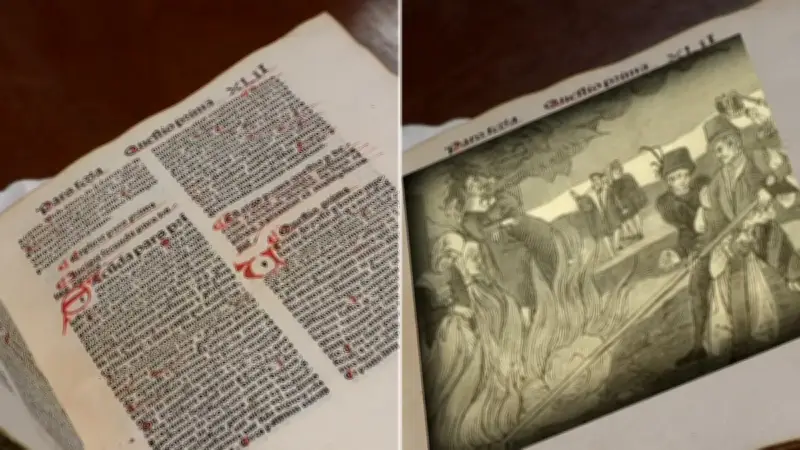
Melbourne University has acquired a 500-year-old book widely regarded as one of the most controversial in history, despite researchers acknowledging its grossly offensive content and its role in inciting mass killings. The book, The Hammer of Witches (Malleus Maleficarum), published in 1494, was purchased for $152,000 and is now housed under tight security in the university’s rare book collection.
A Glimpse into History's Darkest Pages
“To be so close to history and to touch history,” said Susan Millard, Melbourne University Curator of Rare Books. “It’s horrifying really, the content of this book.” Written in Latin by German author Heinrich Kramer, the book claimed that evil witches were everywhere because “women are defective in all the powers of both body and soul.”
“I know that sounds ridiculous now, but I think we still have a lot of ideas circulating that women are somehow lesser, and so remembering what this can lead to is really important,” said Charlotte Millar, senior history lecturer at the university.

The Book's Deadly Legacy
The Hammer of Witches advocates for torture to extract confessions, show trials, and executions. It became Europe’s second highest-selling book after the Bible for a century. “And it then goes on to lead directly and indirectly to the deaths of up to 50,000 people,” Millar said.
Arts student Saskia Scheenhouwer, who had previously studied the book online, found reading the physical copy confronting. “I think it was much more potent. It’s really fascinating to understand why and what impact that had on a society,” she said.
Relevance to Modern Misogyny and Disinformation
Researchers note that some themes in the book are echoed in contemporary society. Millar explained that students often expect misogyny in historical texts but are shocked by the level in this book. “They often recognise things that are being said in the corner of the internet today, and I think they want to see the history of those ideas,” she said.
The university aims to use the book’s horrendous history to help counteract the rapid spread of online disinformation. “I think anything we can do to better understand the past and where dangerous ideas can lead,” Millar said. Millard added: “It’s important not to gloss over history and to bring it to the fore and then look at it in the context of today’s world.”