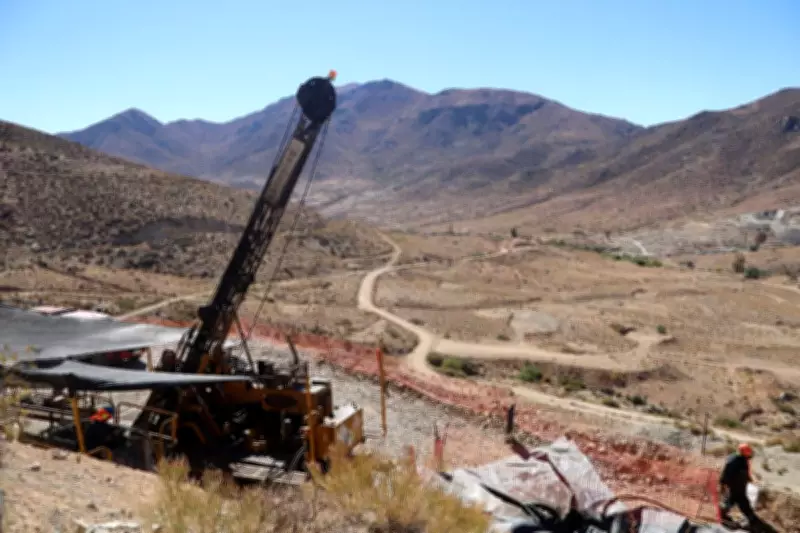
Southern Hemisphere Mining has launched expanded diamond drilling at the company’s Llahuin copper project in Chile, kicking off the latest effort to grow its already substantial 218-million-tonne copper-gold-molybdenum resource.
Previous drilling challenges
The company says its previous reverse circulation (RC) drilling campaign was cut short by groundwater ingress, frustratingly leaving several holes ending in solid copper-gold-molybdenum mineralisation. The new 1000-metre diamond drilling program will effectively pick up where the RC rig left off, pushing four key holes deeper to test the vertical and lateral extent of the known mineralisation.
These are not just speculative probes into the unknown. Southern Hemisphere says its diamond drill “tails” will extend the known mineralisation from RC holes that delivered impressive results right up until they were forced to stop.

Impressive intercepts
One of the headline targets previously returned a whopping 105-metre intercept grading 0.71 per cent copper equivalent from surface right to the end of the hole. This included a significant high-grade zone of 26 metres running at a solid 1.0 per cent copper equivalent from a depth of 78 metres downhole. An entire hole full of mineralisation is nothing to be sniffed at, and the new drilling will now test what lies directly beneath this exciting hit.
The company says it will also extend another hole from 204 metres, after ending in a higher-grade zone that yielded 24 metres at 0.78 per cent copper equivalent from 180 metres. Two additional holes also terminated in broad zones of mineralisation and will be deepened.
Focus on key prospects
The program will focus on three key prospects within the project area – Ferro South, Ferro Central, and Cerro – all of which contribute to the project’s impressive three-kilometre mineralised strike length at the wholly owned Llahuin ground. Adding to the prospectivity of the immediate drill targets, the company says that whilst clearing ground for a recent drill pad at the Ferro South prospect, visible green oxide copper was exposed at the surface, reinforcing near-surface optimism.
Resource base
The Llahuin project already hosts a JORC-compliant measured, indicated and inferred resource of 218 million tonnes grading 0.38 per cent copper equivalent. This comprises a measured and indicated component of 174.1 million tonnes at 0.39 per cent copper equivalent, alongside an inferred resource of 44.1 million tonnes at 0.31 per cent copper equivalent.
Llahuin sits in the heart of a highly prospective belt in the copper capital of the world, Chile, and exhibits the classic hallmarks of a fertile porphyry system. Geological mapping has identified classic alteration zones, with mineralisation near the surface dominated by oxide copper minerals such as malachite and chrysocolla, forming an extensive blanket across multiple target areas.
Joint venture progress
The company’s Southern Porphyry target falls in its joint venture ground with ASX-partner FMR Resources, within a six-kilometre-long mineralised corridor at the broader Llahuin project. The JV partners formalised an exploration arrangement in mid-2025 after FMR joined the fray, funding $13 million in exploration over five years to earn up to 60 per cent of Southern Hemisphere’s Southern Porphyry ground, where deep diamond drilling is already turning up pointers to a lurking porphyry giant at depth.
Other projects
In addition to the Llahuin project, Southern Hemisphere also holds the Los Pumas manganese project, which contains a 30.2-million-tonne JORC resource grading 6.24 per cent manganese. With the drill rigs turning across multiple locations at Llahuin and core already showing promising visual signs of mineralisation, pundits will be hanging out for any visual signs of the all-important copper sulphides, which could be flowing in from drilling over the coming weeks.