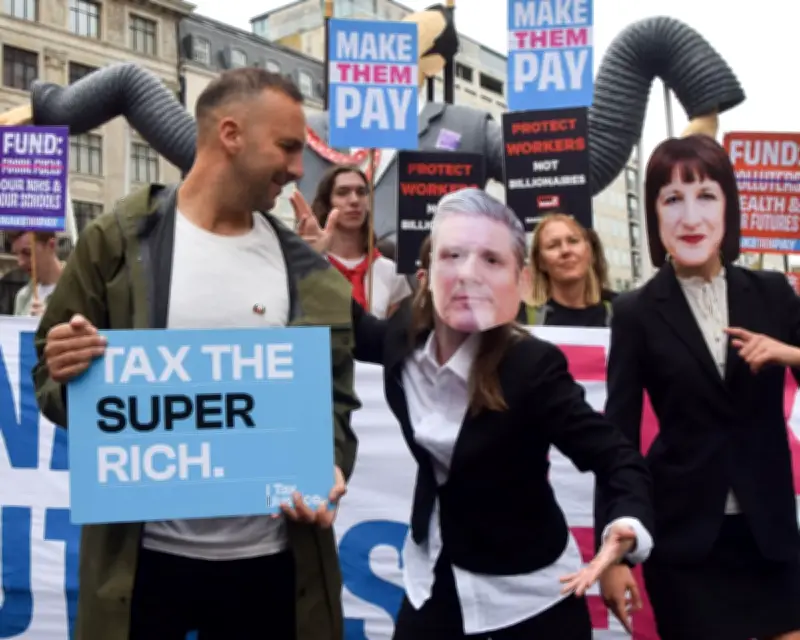
The case for Labour to introduce a wealth tax has never been stronger, as new research shows the super-rich are capturing an ever-larger share of national wealth. With SpaceX's stock market launch sending Elon Musk's fortune to the stars, it is clear that the world's billionaires are running away with the lion's share of the spoils, leaving little for everyone else.
Billionaire Wealth Soars
Research by academics, which has intensified in recent years, reveals just how unequal Western societies have become. They can show with charts and graphs that while 99% of people are paying 40% to 50% tax on their incomes, billionaires are paying a rate equating to 25% at most. As for wealth, the situation is much worse.
Gabriel Zucman, a leading economist, has been determined to show why a wealth tax is needed and how it can be implemented. While much of his study focuses on the US, where data is more comprehensive, it also embraces the UK. He looks back to 1989, when the top 0.001% of families in the Sunday Times Rich List – about 200 of them – owned the equivalent of about 5% of the UK's annual national income, or GDP. It means that if these wealthy people chose to cash in all their shares, properties and pensions, they could buy 5% of all goods and services purchased in that year.

As Zucman explains in his book We Need to Tax Billionaires, published last month, the situation in 1989 was bad, but has become so much worse. He says the top 200 families in the UK now own the equivalent of 22% of GDP, which was just over £3tn for all goods and services produced in 2025.
Zucman's Simple Proposal
Zucman is a professor of economics who commutes between the University of California's Berkeley campus and the Paris School of Economics. Like his Parisian counterpart Thomas Piketty and the late Sir Tony Atkinson, Zucman wants every country to adopt a wealth tax. Rejecting the need for coordination by the OECD or the UN, he says governments should just get on with it. To gain widespread support, his target is people with more than $100m in assets. And to limit pushback, he has settled on a relatively low 2% tax rate. To keep it simple, unlike previous iterations of wealth taxes across Europe, there would be no exemptions.
Andy Burnham and Wes Streeting have sought to blunt the Green leader Zack Polanski's popularity with a hint that a government run by either of them, should they win a Labour leadership race, would favour a tax of some kind on the wealthy. Burnham and Streeting are known to be nervous. The Daily Telegraph recently ran a headline that blazed "Britain needs more wealth creation, not a tax war on billionaires," while the Financial Times joined in with "Wealth tax fears reignited by UK leadership uncertainty."
Yet Labour should see how multimillionaires and billionaires are on the back foot when they argue that a 2% tax on their most extreme wealth is not fair. Zucman's simple tax, which is supported by half a dozen Nobel prize-winning economists, also has a way to counter the threat from the super-wealthy who say "If you go ahead, I'm quitting these shores." The UK could pass a law that considers a long-term resident of the country as continuing to be a resident for tax purposes for five or 10 years after they leave, whether they go to Monaco, Dubai or Milan.
Overcoming Opposition
Setting aside that most people in the rich list do very little "creating" or manufacturing and just trade in property, it will still be difficult to argue that rich business owners need to pay more. It would take for the middle and professional classes to see that a tax on the super-wealthy minimises the need to increase taxes on them. They would also need to understand that creative people do not refuse to start and build businesses because there is a 2% tax on what they might one day own above £100m waiting for them down the track.
Entrepreneurs should know that when they amass more than £100m in wealth it is because they have been extremely lucky, benefiting from a national infrastructure and local amenities created and funded by the state, as well as workers' skills. Megabusiness owners are not islands, and if they lack civic pride and national patriotism, they should acquire some. They should want to make a bigger contribution.

Maybe Burnham, currently the favourite to be prime minister in the autumn if he can win this month's Makerfield byelection, can talk to the nation about how such a shift in tax is not an act of self-harm but a way to begin tackling 40 years during which wealth has become ridiculously unequal and has undermined the fabric of a once-contented nation.