In 2021, singer-songwriter Aimee Mann, known for her work on the film Magnolia, released Queens of the Summer Hotel, an album inspired by Susanna Kaysen's bestselling memoir Girl, Interrupted. Mann had been commissioned to write songs for a stage adaptation that took years to materialize, finally premiering at the Public Theater in Manhattan. The result is a sturdy showcase for Mann's gorgeous, shimmering-sad compositions, but a less successful conduit for Kaysen's arguments.
A Play with Music, Not a Musical
The press materials for Girl, Interrupted emphasize that it is a "play with music," not strictly a musical. This term eludes exact definition, but the production fits comfortably under the rubric of a traditional musical. The songs may not advance the plot, but they offer crucial insight into the inner lives of troubled young women encountered by a fictionalized Susanna at McLean Hospital in suburban Boston.
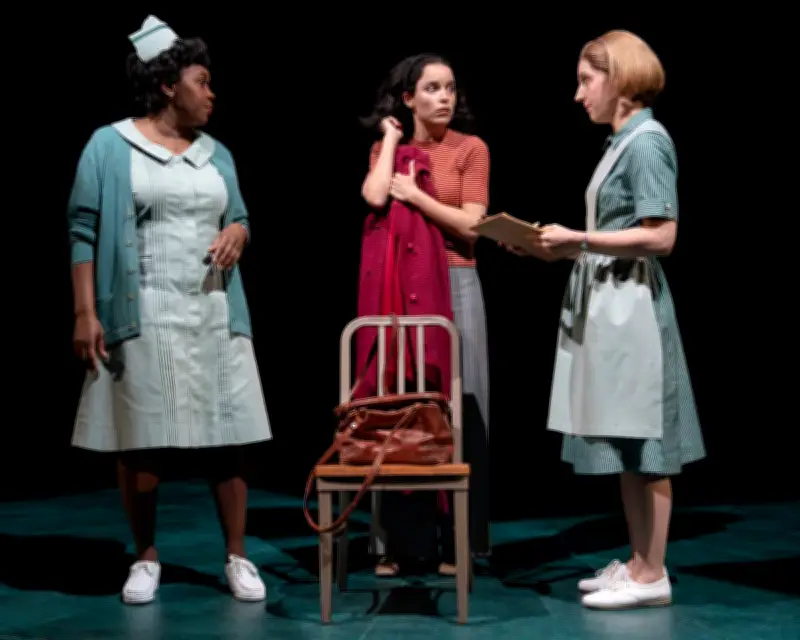
Susanna (Juliana Canfield) arrives at McLean in 1967 after a suicide attempt. She meets an array of young women with different ailments: charismatic Lisa (King Princess), diagnosed a sociopath; roommate Grace (Mia Pak), who has schizophrenia; Daisy (Katherine Reis) with obsessive eating issues; and Polly (Sally Shaw), covered in burn scars from self-immolation.

Familiar Characters, New Interpretation
These characters will be familiar to those who saw James Mangold's 1999 film adaptation, for which Angelina Jolie won an Oscar playing Lisa. This stage version tones down the movie's cinematic overstatement, keeping characters closer to Earth. The production might have played flat without Mann's spare but poetic arias and duets, which let audiences drift inside the minds of these passionate, confused people.
Particularly striking are "Burn It Out," where Polly explains her self-mutilation, and "Robert Lowell and Sylvia Plath," sung by Susanna and Grace as they contemplate the line between creative genius and madness, evoking famous former McLean patients. Each song is sung in rich, melancholy tones, accompanied by piano, violin, and guitar, some played by the actors. Girl, Interrupted is an austere chamber piece, but its music briefly accesses vast abstract thought.
Staging and Performances
Director Jo Bonney's staging is simple, using a turntable and a few chairs, with Heather Gilbert's lighting creating individual spaces and moods. At times, one yearns for more energy, but Bonney and playwright Martyna Majok are determined in their restraint. The result is that the weight of Kaysen's conclusions about her experience may not be felt as powerfully as they should be. Deeper meaning is kept at a remove, delicate and feathery.
Canfield, who worked wonders in Stereophonic, illuminates Susanna's condition with quiet, intelligent firmness, selling the production's reflective conceit. This is adult Susanna looking back at a moment she still does not fully comprehend, confronting the lack of understanding of young women's inner lives with wry resignation.
King Princess, a recording artist, takes the flashiest role and shrewdly underplays it. Unlike Jolie's lupine take, this Lisa is calmer, more a fellow traveler than a domineering alpha. Yet her magnetic pull is still felt; it's easy to see why she is the focus of the group's attention.
Final Thoughts
Still, I would like to know Lisa and all these fascinating people better when they are not singing. Girl, Interrupted is elegant, often engaging theater, but it lilts through its world rather than diving into it. Perhaps Mann's songs were meant to deepen the story, making this more "music with a play attached" than the other way around.