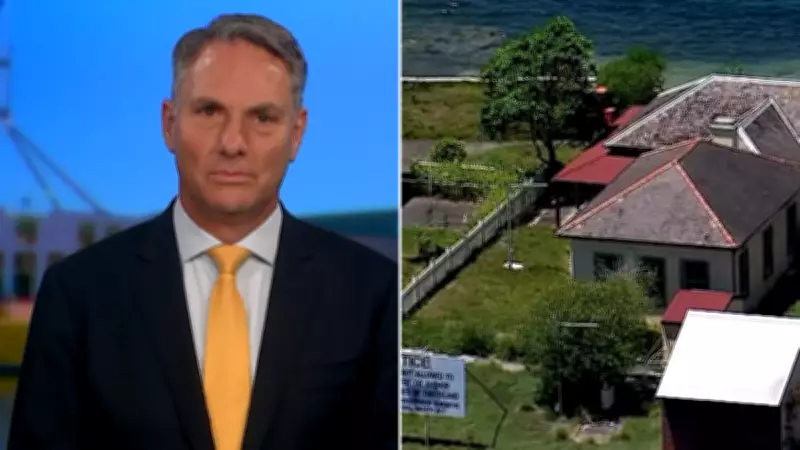
Deputy Prime Minister and Defence Minister Richard Marles has strongly defended the government's controversial plan to sell approximately $1.8 billion worth of historic defence real estate across Australia. The proposal involves divesting dozens of underutilised or vacant Australian Defence Force sites, with Marles firmly rejecting suggestions that this represents a winding back of military presence in major urban centres.
Rationalising Defence Spending on Unused Properties
Under the proposed strategy, numerous iconic defence sites would be sold to generate nearly $2 billion in funds specifically earmarked for military equipment acquisitions and critical infrastructure upgrades. The extensive portfolio spans 35,000 hectares of diverse property types, including islands, air bases, office complexes, golf courses, and rifle ranges that have served defence purposes for generations.
Marles emphasised to Sunrise on Thursday that this initiative represents an "important step" toward rationalising defence expenditure rather than reducing military capability. "We are spending a lot of money on properties that we fundamentally don't use," the Deputy Prime Minister stated, highlighting the financial burden of maintaining underutilised assets.

Specific Examples of Underutilised Defence Assets
The Defence Minister provided concrete examples of properties consuming significant resources without corresponding operational value. Spectacle Island in Sydney Harbour has reportedly cost the government approximately $4 million in security expenses over the past four years, despite having no Australian Defence Force personnel stationed there since 2023.
Similarly, Defence Plaza in central Sydney operates at only 40 per cent capacity despite being a state-of-the-art office facility. Meanwhile, personnel at Victoria Barracks in Sydney occupy accommodation that Marles described as unsuitable for their functions, while more modern facilities remain underutilised nearby.
Addressing Recruitment and Retention Concerns
The property divestment plan faces mounting criticism from veterans groups and defence experts who question its potential impact on military recruitment and Australia's capacity to respond to security crises. Marles dismissed these concerns as a "red herring," asserting that defence recruitment has actually strengthened since the government took office.
"We've got more people showing an interest in joining the Defence Force than we have for decades, and so we're actually getting recruitment going," Marles claimed. He maintained that the property sales would not compromise defence capabilities but rather redirect resources toward more critical priorities.
Strategic Review Drives Property Rationalisation
The proposed sell-off responds directly to findings from the federal government's 2023 Defence Strategic Review, which comprehensively assessed the Australian Defence Force's real estate portfolio against modern military requirements. The review identified 68 sites as candidates for divestment based on their alignment with contemporary defence needs.
Fourteen of these properties are reportedly completely unused yet cost hundreds of millions of dollars annually to maintain. The government plans to sell sites to interested parties on a case-by-case basis, anticipating approximately $100 million in annual savings from reduced maintenance costs alone.
Marles framed the initiative as addressing a long-standing challenge that previous governments had placed in the "too-hard basket." He argued that continuing to secure and maintain properties with minimal defence utility represents an unsustainable financial burden that ultimately detracts from Australia's military preparedness.
The property sales would generate substantial capital specifically dedicated to modernising defence equipment and infrastructure, potentially enhancing Australia's defence capabilities despite the reduction in physical assets. This approach reflects a strategic shift toward optimising defence resources in response to evolving security challenges.