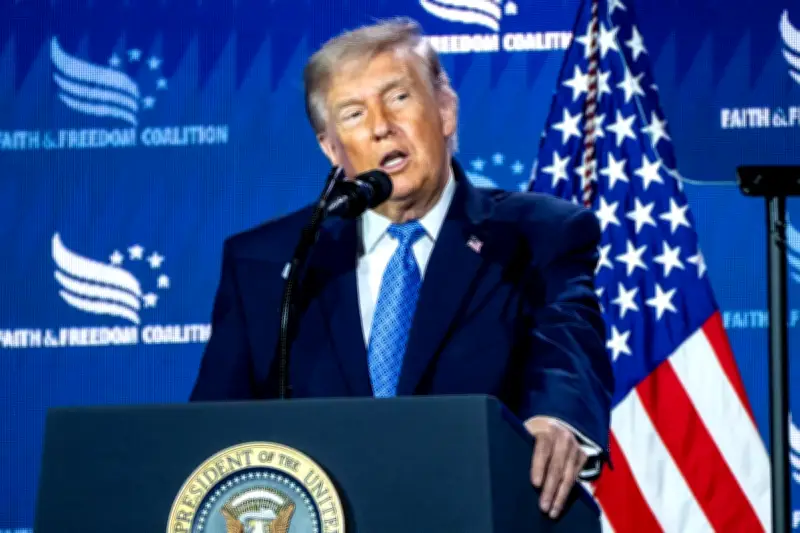
Former President Donald Trump has intensified his political attacks by labeling the Democratic Party as 'communists' during a rally in Texas on Saturday, setting the stage for a contentious midterm election cycle. Speaking to a crowd of supporters in Dallas, Trump declared that the Democratic Party has been taken over by a 'radical communist movement' that seeks to destroy American values.
Trump's Accusations and Their Context
Trump's remarks come as he continues to dominate the Republican Party's base and hints at a potential 2028 presidential run. He specifically targeted Democratic policies on healthcare, immigration, and education, claiming they mirror communist ideologies. 'They want to take away your freedom, your guns, and your God,' Trump said, according to a transcript of his speech. 'They are not just liberals; they are communists.'
The former president's language marks an escalation from his previous characterizations of Democrats as 'socialists' or 'radical left.' Political analysts note that the term 'communist' carries heavy historical baggage in the United States, often used to delegitimize political opponents.

Democratic Response
Democratic leaders swiftly condemned Trump's comments. Senate Majority Leader Chuck Schumer called the rhetoric 'dangerous and divisive,' accusing Trump of trying to incite fear. 'Calling your political opponents communists is not just false; it's a tactic used by authoritarians to silence dissent,' Schumer said in a statement.
Other Democrats pointed out that Trump's own policies, such as tariffs and trade wars, have more in common with state intervention than free-market capitalism. 'Trump is projecting his own authoritarian tendencies onto us,' said Representative Alexandria Ocasio-Cortez.
Impact on Midterms
With the 2026 midterm elections just months away, Trump's incendiary language could energize his base but also risk alienating moderate voters. A recent Pew Research poll shows that 42% of Americans view the Democratic Party unfavorably, but only 12% associate it with communism. 'This is a base play,' said Dr. Emily Harris, a political science professor at Georgetown University. 'Trump is trying to increase turnout among his supporters by framing the election as a battle between patriots and traitors.'
However, some Republicans worry that such extreme labels could backfire. 'We need to focus on issues like inflation and crime, not name-calling,' said a senior GOP strategist who requested anonymity.
Historical Parallels
The use of 'communist' as a political slur has a long history in American politics, from the McCarthy era to recent accusations against progressive figures like Bernie Sanders. Trump's adoption of the term reflects a broader trend of polarizing language in an era of heightened partisan conflict.
As the midterms approach, both parties are gearing up for a fierce battle over control of Congress. Trump's rhetoric may define the campaign, but its effectiveness remains uncertain.