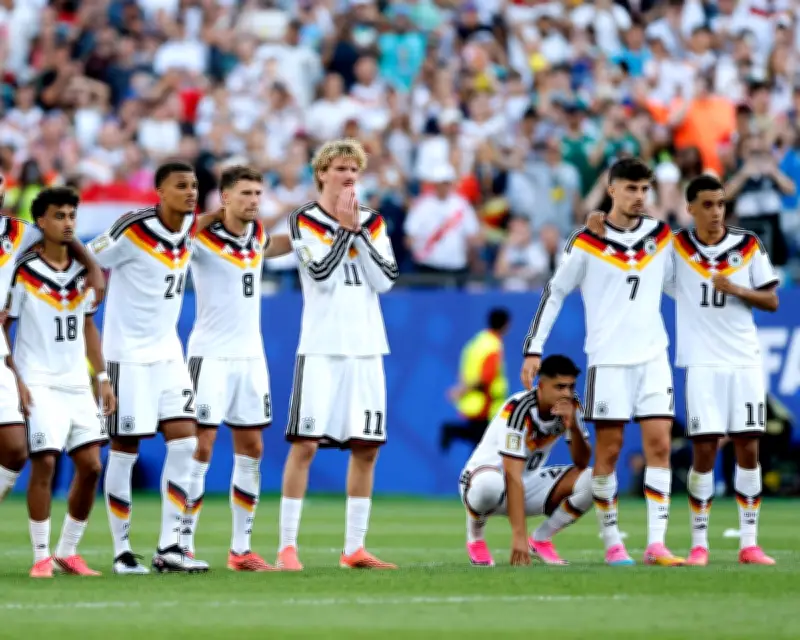
Germany's early exit from the 2026 World Cup has prompted soul-searching within the national team, with pundits and former players arguing the side has lost its identity as a tournament powerhouse. The four-time world champions crashed out in the round of 16 after a 2-1 defeat to Senegal, sparking debate over the direction of German football.
A loss of tournament DNA
Germany had long been known as a tournament team, often peaking at major competitions even when struggling in friendlies or qualifiers. However, recent performances suggest that reputation is fading. Since winning the 2014 World Cup, Germany have failed to advance past the round of 16 in any major tournament, including group-stage exits in 2018 and 2022.
“We are no longer a tournament team,” said former Germany captain Lothar Matthäus. “We used to have a mentality that made us dangerous in knockout games. Now we lack that edge. We have to reconnect with our own identity.”

Disjointed campaign and tactical confusion
Germany's campaign in the 2026 World Cup was marked by inconsistency. They opened with a 3-1 win over Chile but followed with a 1-0 loss to Japan and a 2-2 draw with Morocco, scraping through the group stage on goal difference. In the round of 16, they dominated possession against Senegal but were undone by two counter-attacks, with Sadio Mané scoring a brace.
Coach Julian Nagelsmann came under fire for his tactical approach, switching between a back three and a back four during the tournament. Critics argued the team lacked a clear playing style. “We tried too many things and ended up with nothing,” said former Germany midfielder Bastian Schweinsteiger.
Structural issues beyond the pitch
The problems run deeper than tactics. The German Football Association (DFB) has faced criticism for failing to develop a new generation of elite talent. While players like Jamal Musiala and Florian Wirtz are promising, the overall depth has declined. Germany's youth teams have not won a major tournament since the U-21 European Championship in 2021.
“We need to look at the entire system,” said DFB president Bernd Neuendorf. “From youth development to the national team, we must ensure that German football returns to its roots: discipline, efficiency, and a winning mentality.”
Lessons from the past
Germany have rebuilt before. After a disastrous Euro 2000, the DFB overhauled its youth academies, leading to the golden generation that won the 2014 World Cup. Now, a similar overhaul may be needed. The recent appointment of Rudi Völler as sporting director is seen as a step toward restoring a clear philosophy.
“The identity of German football is about being reliable, physical, and mentally strong,” said Völler. “We have strayed from that. The next two years are about getting back to basics.”
Looking ahead to Euro 2028
Germany will co-host Euro 2028 with Belgium, the Netherlands, and Switzerland, giving them a chance to rebuild on home soil. The tournament offers an opportunity to restore faith among fans and rediscover the tournament spirit that once defined them. “We have the talent and the infrastructure,” Nagelsmann said. “Now we need the belief.”
The defeat to Senegal was a wake-up call. Whether Germany can answer it will determine if they remain a force in world football or continue their slide into mediocrity.