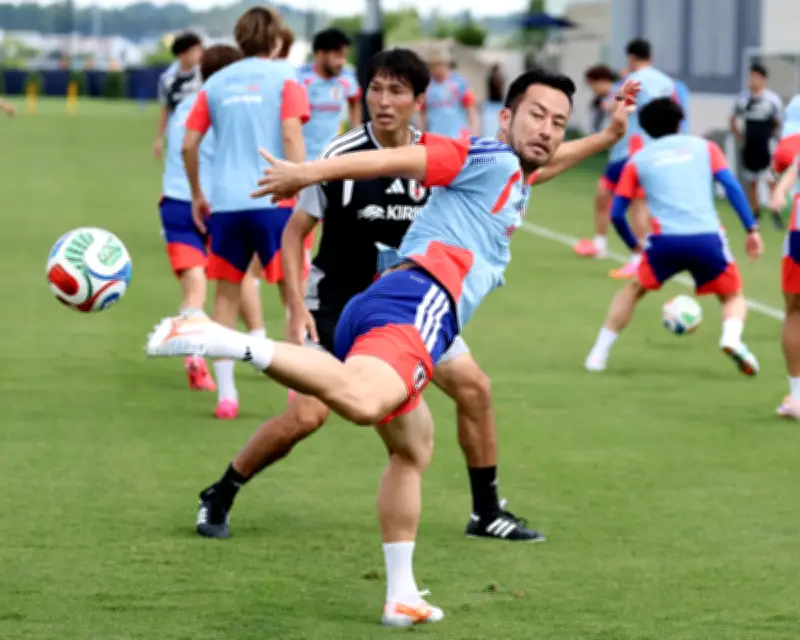
Being the best in Asia is no longer enough for Japan as they seek a World Cup breakthrough. Despite missing key players, Hajime Moriyasu’s side have built strength in depth to challenge the traditional order.
A History of Near Misses
In 2002, there was a sense that Japan had slightly missed an opportunity. South Korea may have enjoyed the benefit of some favourable refereeing, but they also impressed. They were quick, technically good and tactically extremely flexible and progressed to the semi-final of their home World Cup. Japan did not do much wrong, topping their group before going down 1-0 to Turkey in the last 16, but the contrast with their co-hosts was inevitably underwhelming.
Although Park Ji-sung and Lee Young-pyo earned moves to PSV off the back of South Korea’s performances, and subsequently joined Manchester United and Tottenham respectively, Japan already had four players with European clubs, although one of them, Junichi Inamoto, had briefly returned to Gamba Osaka from his loan at Arsenal before leaving for Fulham. He never played a league game for Arsène Wenger, his next permanent move taking him to West Brom, where he struggled to make an impact.

Mental Block and Recent Progress
In the past two decades, Japanese and South Korean players have become increasingly familiar in European leagues, but Japan are still to make it beyond the last 16 of a World Cup, something their manager, Hajime Moriyasu, has admitted has become a mental block. In 2010, after outplaying Cameroon and Denmark in the group, they allowed themselves to be dragged into a stalemate of ferocious tedium by Paraguay, losing on penalties. They tossed away a two-goal lead against Belgium at that stage in 2018 and then, in 2022, having beaten Spain and Germany in the group, ran into Croatia with predictable consequences.
This Year Feels Different
But this year, perhaps, is different. As Japan start their World Cup campaign against the Netherlands in Arlington on Sunday, it feels genuinely possible that they are not merely the best Japan side in history, but the best Asian side to play at a World Cup. Moriyasu has been in the job since 2018 and, as such, is the longest-serving Japan national manager ever. He has been bullish about Japan’s chances, talking openly of winning the competition.
Japan won six out of six in the first round of qualifying and then seven out of 10 in the second, losing just once, a remarkable achievement given the distances involved and the huge variety of opponents and conditions. But being the best in Asia is no longer enough, and a run of six successive friendly wins since, including over England and Brazil, is arguably even more important than qualifying with three games to spare, for reasons of self-belief if nothing else.
Injuries and Depth
Injuries have hit them hard. The captain Wataru Endo withdrew from the squad this week, while the loss of Kaoru Mitoma to a hamstring injury sustained playing for Brighton against Wolves in May is a major blow, particularly with Takumi Minamino rupturing his anterior cruciate ligament. It says much about the development of Japanese football, though, that their absences are not seen as terminal. That Minamino has travelled with the squad to offer moral support suggests their togetherness.
Mitoma is a loss not only because of his quality but also his versatility. He could play either as one of two creators in Moriyasu’s 3-4-2-1, or at left wing-back. Keito Nakamura looks all but certain to operate wide on the left, but there are various options to play off the Feyenoord centre-forward Ayase Ueda. Takefusa Kubo was regarded as the rising star of Japanese football when he joined Barcelona’s la Masia academy at the age of 10 and signed for Real Madrid at 18. Now 25, he has settled at Real Sociedad and will probably be the right-sided creator. The role on the left, though, could go to Celtic’s Daizen Maeda or Genk’s Junya Ito, or potentially a more defensive figure such as Daichi Kamada of Crystal Palace. The depth of options is itself an indication of Japan’s development.

Group and Tournament Outlook
The group is not easy to read. The Netherlands, given a midfield that should be able to hold possession and a hugely varied forward line (they have heft in Wout Weghorst and Brian Brobbey, but also pace and subtlety in Memphis Depay, Donyell Malen, Crysencio Summerville and Noa Lang) but they have been ravaged by injuries and fatigue.
Sweden were awful in qualifying but have been re-energised by an improbable messiah in Graham Potter. Tunisia exist in a state of constant paranoia and overcaution, but the appointment of Sabri Lamouchi and a much-changed squad might at least remove some gloomy memories from a miserable Cup of Nations campaign six months ago.
The group winners and runners-up face the runners-up and winners from the Brazil, Morocco, Haiti and Scotland group, which is far from straightforward. The draw could have been a lot kinder, but hope remains, with Endo this week talking of a quarter-final as a first goal.
In 1992, just before the launch of the J League, Japan announced a plan to win the World Cup by 2092. In 2005, after two appearances, they brought that target forward to 2050. For a side that has never got beyond the last 16 to speak of victory may feel premature, but there is little doubt that, at this moment, Japan have surpassed South Korea. And while Senegal and Morocco are clear contenders, if there is to be a winner from outside Europe and South America, Japan look as well placed as anybody.