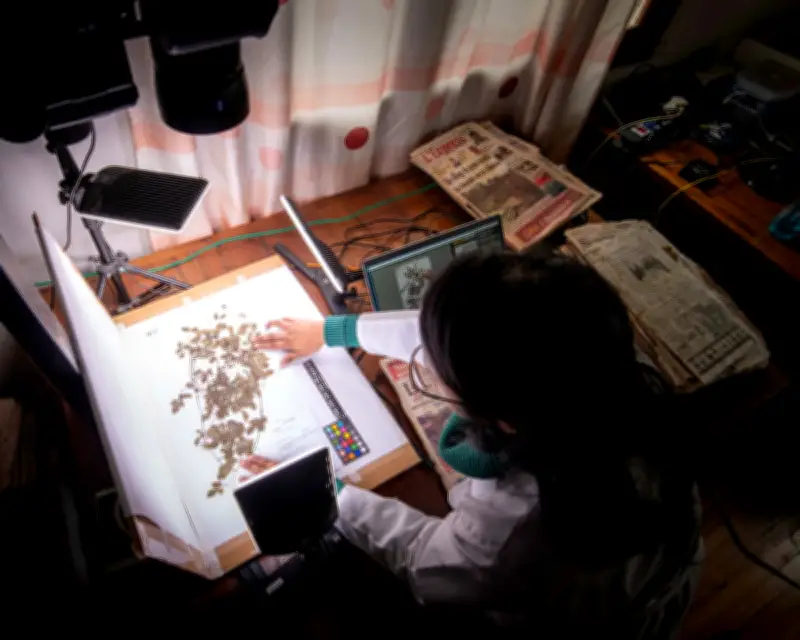
A major report from the Royal Botanic Gardens, Kew, suggests that artificial intelligence and digitisation could be a turning point in the “race against extinction” faced by botanists working to identify and save vital plants before they disappear.
New Technology Transforming Plant Science
New technologies are enabling scientists to track shifts in flowering times around the world, rapidly identify new specimens, and extract crucial genetic data from 180-year-old fungus specimens, potentially unlocking a “genomic goldmine”. The digitisation and online availability of millions of specimens that were previously only accessible in archives is also generating new insights, particularly in the global south.
Plants and fungi underpin all life on Earth by providing food and medicines, storing carbon, and regulating the climate. However, approximately 40% of the 70,000 plant species that have been assessed are at risk of extinction, while another 330,000 have yet to be analysed. Scientists believe there are another 100,000 plant species still to be named.

Urgent Need for Discovery
About 2,000 new plant species are recorded each year, but this “barely scratches the surface,” according to Professor Alexandre Antonelli, executive director of science at RBG Kew. This means potential new medicines and sustainable crops are going extinct before they are even discovered.
The situation is even more critical for fungi, with 90% of an estimated 2 million species still unknown to science and less than 1% of known species assessed for extinction risk. “While documenting and protecting all life on Earth remain formidable challenges, digitisation and accompanying technologies make me increasingly hopeful that we’ll succeed,” said Antonelli.
AI Enhancing Identification
AI can learn to identify challenging plants, such as sedges and peat mosses, whose distinguishing features are microscopic, allowing new or vulnerable species to be spotted faster. “These AI models can sometimes now identify better than specialists – that’s incredibly exciting,” Antonelli noted.
Digitising images and collection data of plant and fungi specimens also accelerates international collaboration and can open up important but rarely accessed collections in biodiversity hotspots, such as Madagascar. Landy Rajaovelona, a senior botanist at Kew Madagascar, stated: “Madagascar is one of the world’s most extraordinary biodiversity hotspots. By digitising [37,000 physical specimens], we’ve unlocked a treasure of knowledge spanning centuries, offering invaluable insights into today’s biodiversity.”
Global Digitisation Efforts
RBG Kew has now digitised all 7.4 million of its specimens, including those collected by Charles Darwin, and these are freely available online. The four-year programme involved taking 20,000 high-resolution images a day at its peak. In total, there are 145 million digital specimens now online globally, but this represents less than 16% of the total held in herbariums, leaving “huge blind spots in understanding,” the scientists said.
Climate Change Impacts on Flowering
The report also features a global study using an AI model trained to spot flowers that analysed 8 million digitised specimens. It revealed that flowering has shifted by an average of 2.5 days per decade over the last century due to the climate crisis. Changing rainfall patterns and rising temperatures have caused some flowers to arrive later and others to come earlier.
This can severely disrupt ancient relationships between plants and the pollinators and other animals that depend on them at specific times of year. For example, a study using herbarium specimens showed that about 80% of the kindal trees in India’s Western Ghats, which are important for timber, used to flower at the same time. By the 1990s, that figure fell to less than half.
Genomic Goldmine from Fungi
New technology is also unlocking genetic secrets from fungi, with scientists now able to produce high-quality genomes from very old specimens, some up to 180 years old. The researchers said the breakthrough makes historical fungarium specimens a “genomic goldmine” for new medicines and the prediction of disease outbreaks. Penicillin and statins were derived from fungi.

“Fungi are very opportunistic and they love heat and humidity,” said Dr Esther Gaya, senior research leader at RBG Kew. “Some human pathogens seem to be spreading from warmer places as the hot season gets longer in temperate regions.”
Concerns and Cautions
There are concerns over the heavy use of energy and water by AI datacentres, acknowledged by the report’s authors. The Guardian reported in May that datacentres are now consuming 6% of electricity in the UK and US. OpenAI’s boss, Sam Altman, said in February: “It also takes a lot of energy to train a human.”
The report, produced by 400 scientists across 40 countries, cautions that using digitisation and AI could amplify existing biases and inequalities unless the underlying data is expanded and improved. It called for partnerships between technology companies and environment organisations, and for governments and funders to invest in plant and fungi collections.