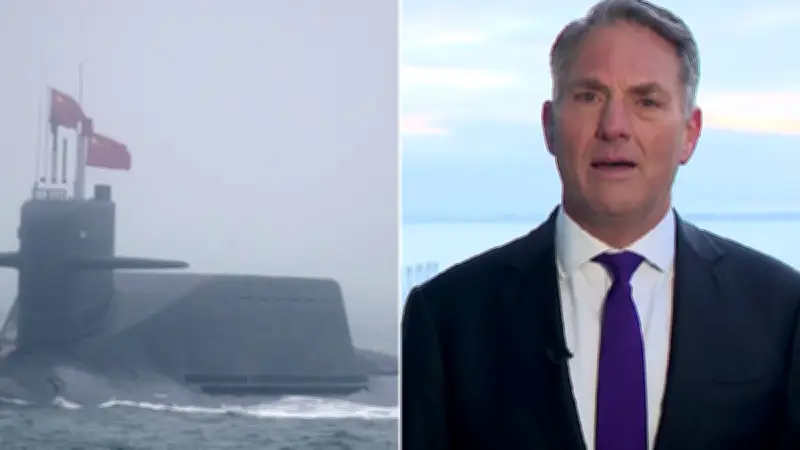
Deputy Prime Minister Richard Marles has labelled China’s latest nuclear-capable missile test “hugely destabilising”, warning the launch demonstrates Beijing’s growing military capability. China test-fired a nuclear-capable intercontinental ballistic missile into the Pacific Ocean on Monday afternoon. The missile, with a dummy warhead, landed between Nauru and Tonga after being launched from a nuclear-powered submarine. The launch came just hours after Australia signed a historic defence agreement with Fiji under the Vuvale Partnership, with the Australian government receiving only two hours’ notice before the test.
Despite the limited warning, Marles said Australia’s primary concern was not the notification itself but the capability China had chosen to demonstrate. “Our concern is the capability that’s being demonstrated here, a much longer range capability and one which China itself is saying is nuclear capable,” he said. He said the test formed part of a much broader military expansion by Beijing. “We are seeing them engaging in a very significant military build-up,” Marles said. “We are seeing the biggest conventional military build-up in the world since the end of the Second World War. That’s what China is undertaking.”
Strategic reassurance lacking
Marles said Australia routinely explained its defence investments to regional partners, but China had not provided the same strategic reassurance. “When we increase our defence spending or get a new capability, we spend a lot of time talking to countries around the world about why we’re doing it and what our intent is,” he said. “We don’t have that from China. And that is what’s fundamentally destabilising.”

Defence analyst and former Navy warfare officer Jennifer Parker said receiving just two hours’ notice was highly unusual. “There’s no international law requirement apart from the requirement of due diligence, but no, that’s not normal practice,” Parker said. “It’s also not normal practice for China to fire these long range intercontinental ballistic missiles into the Pacific.” She said while the United States conducts similar tests two to three times a year, it typically provides at least a day’s warning. “This was a surprise,” she said.
Timing raises questions
The timing of the launch has prompted questions about whether it was intended to send a message following Australia’s new defence pact with Fiji, a move China is reportedly unhappy about. “I think this is clearly a demonstration of capability,” Parker said. “There are other ways for China to test this capability rather than firing into the Pacific between Nauru and Tonga.” However, Parker cautioned the operation would have required extensive planning and may not have been specifically timed to coincide with Prime Minister Anthony Albanese’s visit to Fiji. “To prepare for these kind of long-range firings takes a lot of planning to get one of these capabilities to sea with a dummy warhead,” she said.
Parker said the launch was about far more than testing a missile. “Make no mistake, this is not about testing the missile. There are other ways to test the missile. This is a demonstration of China’s long-range capability and the fact that they can reach out and touch countries like Australia,” she said. The last time China conducted a similar missile test was in 2024, with the previous launch before that occurring around 1980.