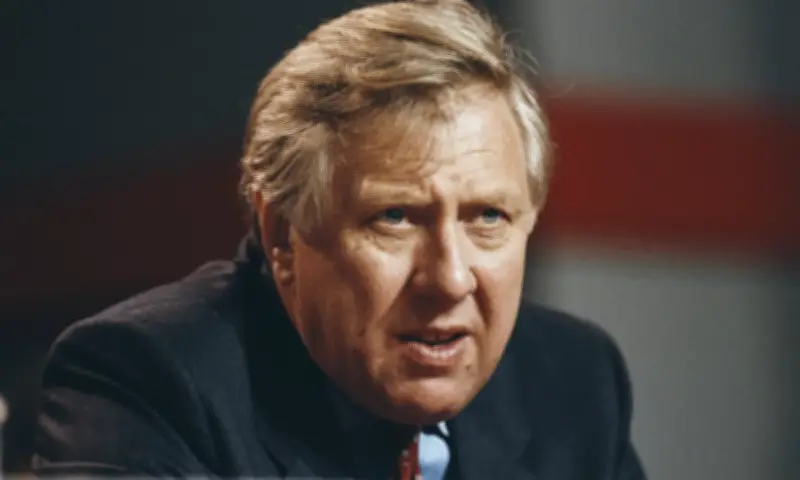
Roy Hattersley, the former deputy leader of the Labour Party who was a key figure in British politics for decades, has died at the age of 93. A politician, journalist and author, Hattersley was known for his fierce defence of democratic socialism and his willingness to take on ideological battles within his party.
Early Life and Political Beginnings
Born in Sheffield on 28 December 1932, Hattersley grew up in a Labour-supporting family. His mother, Enid, was a long-serving city councillor and later lord mayor of Sheffield. His father, Frederick, was an ordained priest who had a dramatic love story with Enid, running away with her shortly after her marriage to another man. Hattersley learned of this only after his father's death in 1973.
He attended Sheffield City Grammar School and later Hull University, where he studied economics after giving up a place to read English at Leeds on advice that it would be politically advantageous. In 1954, he served as president of the National Association of Labour Students, the first from a provincial university. He married Molly Loughran, a teacher, and at 23 became the youngest Sheffield City councillor, chairing the housing management committee and commissioning the Park Hill high-rise development.

Parliamentary Career
Hattersley was elected MP for Birmingham Sparkbrook in 1964, becoming the youngest MP in that intake. He quickly identified with the Gaitskellite right and aligned himself with Roy Jenkins. Within three years, he was the youngest minister in Harold Wilson's government, serving as joint parliamentary secretary at the Ministry of Labour. He later served under Barbara Castle at the Department of Employment and Productivity, where she called him "an able, tough, unscrupulous little tyke."
During the Troubles in Northern Ireland, while Denis Healey was recovering from surgery, Hattersley sent British troops into Ulster, a decision that shaped his lifelong concern for the province. He was a strong pro-European and voted with the Conservative government to support UK membership of the European Economic Community in 1971, despite Labour's official opposition.
When Labour returned to power in 1974, Hattersley was left out of the cabinet initially, becoming deputy to foreign secretary Jim Callaghan. He entered the cabinet in 1976 as secretary of state for prices and consumer protection, a role that put him in conflict with trade unions during a period of high inflation and pay restraint. He blamed the unions for Labour's 1979 election defeat but also criticised his own government for accepting the 1976 IMF bailout.
Deputy Leadership and Internal Battles
After Labour's defeat in 1979, Hattersley became a key figure on the party's right. He refused to join the Gang of Four who formed the SDP in 1981, instead leading Labour Solidarity to fight the Militant tendency. He became shadow home secretary under Michael Foot and contested the leadership in 1983, losing to Neil Kinnock but becoming deputy leader.
For a decade, Hattersley served as Kinnock's deputy, often at odds with his flamboyant style but recognising the need for internal reforms. He authored Labour's Choices (1983), later revised as Choose Freedom, which argued that without equality, liberty is meaningless for the majority. He was shadow chancellor from 1987 to 1992, a period that included a controversial pledge to raise taxes for higher earners.
After Labour's fourth consecutive defeat in 1992, Hattersley and Kinnock resigned their leadership. Hattersley had genuinely believed they would win, telling a rally in Sheffield: "It is the election for which I have waited since I joined the Labour party in this city on my 16th birthday."
Later Life and Writing Career
Hattersley left the Commons in 1997 and was made a life peer, retiring from the Lords in 2017. He embarked on a highly successful writing career, publishing more than 20 books including novels, memoirs, biographies of figures like John Wesley and David Lloyd George, and a history of the Salvation Army founders. His Endpiece column appeared in the Spectator, the Listener and The Guardian until 2005, and he also wrote for the Daily Mail and New Statesman.

He never abandoned politics, criticising Tony Blair's modernisation and later Jeremy Corbyn's leadership, particularly over antisemitism and Brexit. He supported Keir Starmer and continued to argue for a clear articulation of Labour's purpose.
Hattersley divorced Molly in 2013 and married his literary agent Maggie Pearlstine later that year. She survives him. Roy Sydney George Hattersley was born on 28 December 1932 and died on 13 June 2026.