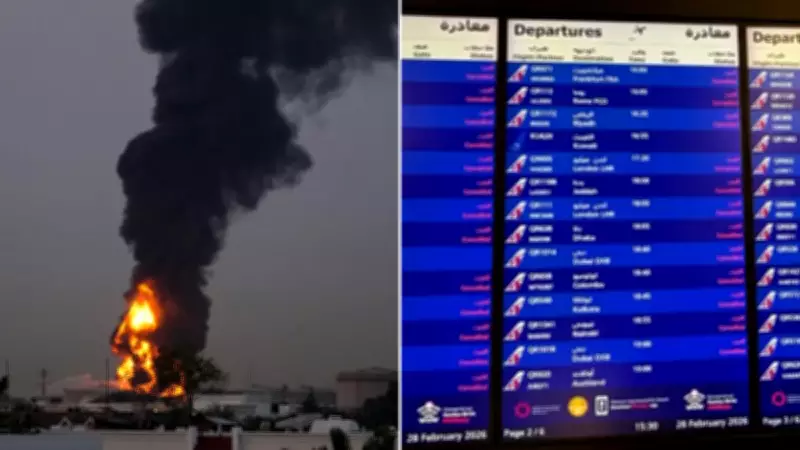
Air travel and global shipping are facing growing disruption as fresh strikes between the United States and Iran rattle a fragile ceasefire and threaten key routes through the Middle East.
Flights Diverted After Drone Attacks
Flights bound for Dubai have already been diverted following new drone attacks on the United Arab Emirates, while renewed clashes in the Strait of Hormuz are slowing the movement of commercial vessels through one of the world’s busiest shipping lanes.
The United States Navy is now escorting stranded ships through the strait as part of “Project Freedom”, but experts warn that could further inflame tensions and disrupt air travel in the days ahead.

Expert Analysis on Ceasefire Stability
Dr Rodger Shanahan, Middle East analyst and former army officer, said the situation remains highly unstable following today’s exchange of strikes.
“At the moment, it appears, for now at least, that it is a one-off. But I don’t think we have 100 per cent confidence in this ceasefire holding,” he said.
He warned any escalation would have immediate consequences for travellers and global trade.
“It’s really in the lap of the White House at the moment about how they’re going to respond to this or whether they’re going to continue to prosecute this latest operation, which will inevitably have retaliation from Iran as a result, and if that’s the case, it’s pretty obvious that there’s going to be disruptions to air travel through that part of the world, so people should probably factor that into their considerations,” Shanahan said.
Shipping Crisis in the Gulf
At sea, the situation is equally tense, with hundreds of ships still stranded in the Gulf as military activity intensifies around them.
Former US Air Force Lieutenant General Richard Newton said the next phase of the operation would focus on moving those vessels out, but warned conditions could worsen.
“So far so good,” he said, adding it would be “a rough next couple of days”.
“Consider this now phase two. This blockade has been very effective up until this point. Phase two is now to get these ships out of there, and then, really, the objective here is to get the strait opened up for commercial shipping,” he said.
Ceasefire at Risk
Despite the escalation, both sides are still avoiding formally declaring the ceasefire over, though repeated attacks could quickly change that.
“One drone doesn’t necessarily make for that to happen, but if you get multiple drones or if you start putting in multiple ballistic missiles, that could see an end to the ceasefire,” Newton said.
A breakdown would likely trigger wider disruption across global aviation routes and commercial shipping through the Gulf.