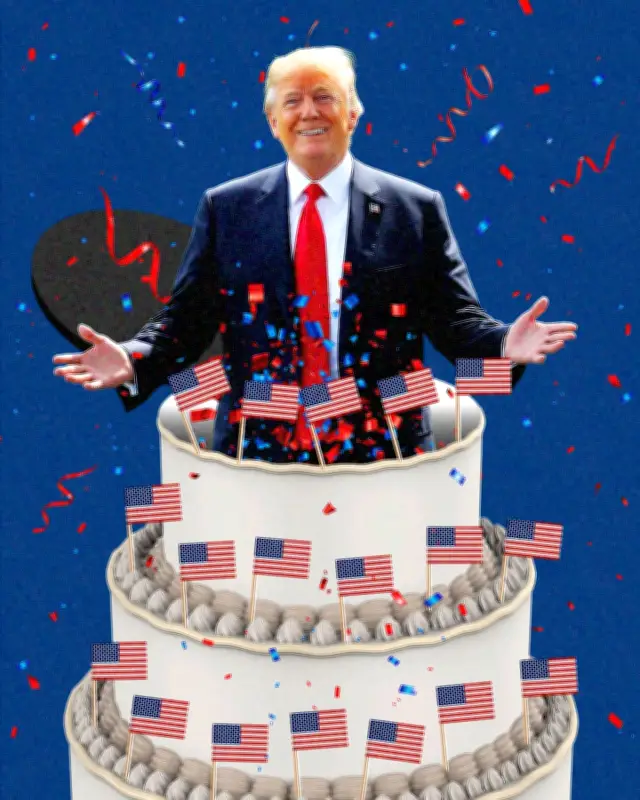
Donald Trump has hijacked America's 250th anniversary, transforming the milestone birthday into a 'theatre of the absurd' that has left the nation feeling joyless and divided. The president, who has long hyped the semiquincentennial and expressed glee that it falls in his second term, is presiding over a series of events that critics say are more about his own vanity than a unifying celebration of the country's founding.
Two and a half centuries after the signing of the Declaration of Independence in Philadelphia, the anniversary has become a cue for rancor and existential angst. Eddie Glaude, author of America, U.S.A.: How Race Shadows the Nation's Anniversaries, described a sense of dread. 'It's going to be a collage of terrible myth-making,' he said.
Washington DC Transformed into a Gaudy Pageant
In Washington DC, the official epicenter of the nation's birthday party is looking less like a dignified civic jubilee than a gaudy reality TV pageant. Trump launched a project to beautify the capital, but a $14.7m renovation of the Lincoln Memorial reflecting pool went awry when an algae bloom turned the water bright green and the 'American flag blue' coating began to peel off. Trump blamed vandals and threatened them with jail time.

The tone was set on 14 June, when Trump commandeered the White House South Lawn for brutal Ultimate Fighting Championship cage matches. Last week, he kicked off the Great American State Fair on the National Mall, effectively a Trump rally with military jets overhead, hastily arranged after performing artists withdrew over the event's partisan nature. Transportation Secretary Sean Duffy railed against 'those libtards that cancelled on us' and praised Trump as 'the greatest president that's ever existed in this country since George Washington.' The affair featured no Democrats and culminated with Trump's 'Make America great again' battle cry and a dance to YMCA by the US Marine Band.
A Joyless Celebration Amid Culture Wars
The state fair, running for 16 days, includes all 56 states and territories, though some opted not to send a delegation due to Trump's hands-on approach. Described by the Washingtonian as 'sparsely attended and shockingly boring,' it features a ferris wheel plagued by power cuts. On 4 July, the mall will host a 'Salute to America' celebration with Trump and an attempt to break the Guinness world record for the biggest firework display. In August, IndyCar descends on the capital for the inaugural Freedom 250 Grand Prix.
These events came after America250, the official bipartisan commission established by Congress, was sidelined in favor of Freedom 250, a Trump-aligned initiative. America250's modest ambitions include a time capsule, an essay contest, and a concert on 4 July featuring Queen Latifah, Chris Stapleton, and the Smashing Pumpkins.
Historians and Public Express Gloom
David Blight, a professor of American history at Yale University, said, 'I don't feel celebratory at all. I don't know how to explain [Trump's] vanity projects any better than anybody else. This is who he is. He's not unlike Mussolini, who wanted to leave his mark all over Rome. It's like theatre of the absurd.' Jill Lepore, a professor at Harvard University, noted that other semiquincentennial gestures seem muted. 'To be doing something is somehow to seem as if you're supporting Trump to some people, which is ridiculous,' she said.
A Reuters/Ipsos poll found that 38% of respondents do not believe the US will exist as a single country 250 years from now, and nearly two in three Americans agree that their democracy is in danger of failing. Even among conservatives, there is mourning for what could have been. Bill Whalen of the Hoover Institution said, 'Ideally, the celebration of the 250th anniversary should be the equivalent of the Christmas truce of World War I, where people put down their weapons and got together.'

Contradictions and a Struggle for the Nation's Soul
The anniversary has also highlighted America's ongoing struggle with its original sin of slavery and its contradictions. The Declaration of Independence's author, Thomas Jefferson, enslaved over 610 people. In 1776, more than 400,000 African Americans lived in slavery, women could not vote, and Native Americans were removed from their lands. Lepore said, 'You can easily understand American history from the beginning as a contest between competing ideas of liberalism and illiberalism. We're frozen in that battle.'
Glaude views the current moment as an echo of 1926, when the Ku Klux Klan marched on Washington and President Coolidge rejected the idea of striving for a 'more perfect union.' Trump, he argues, has echoed that rhetoric by 'yoking the perfection of the country to himself.' Beneath the Freedom 250 bombast, some perceive a conscious effort to rewrite the American narrative into an exclusionary myth of white, male Christian triumph. A fleet of 'Freedom Trucks' have been traveling the country telling a relentlessly positive story that downplays slavery and culminates with a video of Trump.
Robert P. Jones of Public Religion Research Institute noted that a 'Rededicate 250' event on the National Mall featured an explicit evangelical Christian message with no representation from historic Black denominations. He argued that this overt Christian nationalism is driven by demographic panic, as the percentage of white Christians in the US has dropped from 81% in 1976 to about 40% today.
Quiet Resistance and Hope
Despite the partisan spectacles, some cultural institutions are engaging in quiet resistance. The Museum of the American Revolution in Philadelphia features an exhibition, The Declaration's Journey, that maps the declaration's influence on freedom movements worldwide. Curator Tyler Putman highlighted Martin Luther King Jr.'s use of Jefferson's words in his 'Letter from Birmingham Jail.' The exhibition includes draft cards from World War I where Black soldiers wrote 'We hold these truths to be self-evident' across the torn corners.
In Montgomery, Alabama, the Freedom Monument Sculpture Park commemorates the millions who lived and died in slavery. At the Smithsonian Castle, curators point to the Eniac computer, whose earliest programmers were women. Away from official events, there are different songs of the summer: Zohran Mamdani capturing the euphoria of New York Knicks fans, Barack Obama opening his presidential centre in Chicago, and football fans bringing joy to the World Cup.
At Independence Hall, visitors still come. Kim Wilson, 52, from Raleigh, North Carolina, said, 'It was so wonderful to be in the room where so many people took such courage to do things that were very difficult. I feel like we've lost a lot of courage to do very difficult things as a people.' Dimitrios Dimoulas, a Brazilian immigrant who became a US citizen in 1976, insisted the malaise is a passing phase: 'No matter who you are and what you are, you've got to listen and learn. That's all we need. Sooner or later, this is going to pass.'