
Mahnaz Mohammadi, an Iranian film-maker and women's rights activist, has survived multiple arrests and imprisonments. In 2011, she endured months in solitary confinement and torture. In 2014, she was sentenced to five years and served several months. Years later, she met one of her first interrogators, who told her: 'He said to his colleagues that after doing all those things, if I were going back behind the camera, it meant they couldn't do anything with me.' Mohammadi reflects: 'When I heard this from his mouth, I thought: “He’s right! Nobody can hurt me.”'
Constant Fear and Surveillance
Despite her resilience, Mohammadi remains vigilant. She left Iran to complete her latest film and stays in Europe on a three-year visa. Recently, a journalist disclosed her city of residence. 'I thought, now I have to move. I’m not afraid of dying but I don’t feel safe. It’s not a good feeling,' she says.
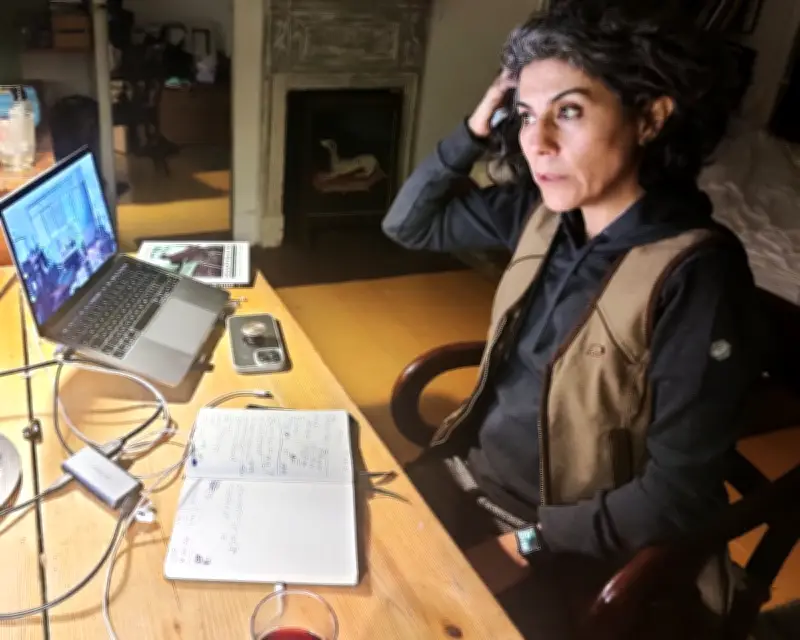
Meeting at a friend's house in London, Mohammadi, 51, screens two new films. Her manner is gentle, her voice soft, but her gaze steady: 'You can ask me anything.'

The Making of 'Roya'
For years, Mohammadi wanted to make a film about prison but hesitated, partly due to reactions when discussing her experiences. Friends sometimes rolled their eyes, saying: 'Do you want credit for being in prison?' She recalls: 'They’d say: “Do you want credit for being in prison?” I’d say to them: “You don’t have any idea of what happened in there.”' This left her more isolated. 'I thought maybe I’d just be quiet.'
Now, she has written and directed the fictional drama Roya, drawing on her own and others' experiences. The film is harrowing but not graphic; she says: 'I censored a lot.' It follows a university professor, Roya (played by Turkish actor Melisa Sözen), accused of inciting students to burn headscarves. Like Mohammadi in 2011, Roya is held in solitary confinement in Evin prison and tortured. The light flickers constantly, making it impossible to tell day from night.
An Unsettling, Experimental Film
The film unfolds with the logic of a nightmare. For the first 20 minutes, it is shot entirely from Roya's point of view. When a guard takes her to interrogation, the audience is under the chador with Roya, barely able to see. Details are terrifying: blood smeared on lift buttons, a prisoner begging to breastfeed her newborn. The sound design is battering. Throughout, Roya utters not a word.
In the second part, she is released on three-day compassionate leave—or so it seems. After months of torture, it is hard to know what is real. The film opens with Roya reading graffiti on cell walls, tracing them with a finger—an autobiographical detail. Mohammadi explains: 'It helped me get through isolation. Then one day, I stole a pen from my interrogator and I started writing for the next woman – “I was here. Now I’m not. You will not stay for ever. I’m gone. You will be gone. Don’t worry.”' After release, a woman imprisoned in the same cell told her: 'Mahnaz, you saved my life!'
Impact of Imprisonment
Mohammadi describes low points in prison. During one interrogation, she was told her father was dead. He had been told she died and was arrested. 'They tortured both of us at the same time,' she whispers, eyes filling with tears. 'I felt so guilty. I was thinking I should kill myself. Because if I get out, how can I look into the eyes of my family?'
Prison changed her fundamentally. 'I’m not the same. The Mahnaz who went to prison was a different person. When I came out my identity was shattered.' After release, she spent almost two years at home, barely seeing anyone, supported by a few friends—'mostly women. I would cook for them. I’m a good cook.' Prison destroyed her trust; during interrogation, she learned friends and colleagues had informed on her, hearing recordings.
Defying the Regime
Banned from filmmaking since her 2019 debut Son-Mother, Mohammadi is not alone. Earlier this month, Tehran's revolutionary court upheld a one-year prison sentence for Oscar-nominee Jafar Panahi for propaganda. Mohammad Rasoulof escaped to Germany in 2024 after an eight-year sentence and flogging for The Seed of the Sacred Fig.

Mohammadi defied the regime to make Roya, shooting exterior scenes in Iran without permission. She avoids discussing how, fearing for colleagues. Prison scenes were shot in Tbilisi, Georgia. She says: 'I never think about limitations. As a woman, since you are born, they put the scarf on your hair. And they don’t put just a scarf on our heads. They put limitations on our way of thinking. That’s why I never think about the limitations and censorship. I only think about what I can do.'
Personal Exposure and Future
Does making such a personal film feel exposing? 'You feel naked,' she says. 'But there are so many people inside Iran still in prison. Until the last one is there, I will do whatever I can. I can’t do big things. But I can do small things, like make films.' She recently directed a documentary, Beyond the Lies, about the regime's suppression of November 2019 protests. Her current project is a documentary with Channel 4 about women in Iran.
Mohammadi grew up in a cultured, middle-class home. Her father, a businessman, welcomed her after first prison release: 'He said to me: “Amazing Mahnaz. Now you’re really my daughter.” I was lucky to have such a dad, because some people after prison, their family rejects them. If I’m surviving, it’s because I was privileged.'
At 15, she won a story competition on children's radio and worked for four years, writing before school. The station suggested she try reporting, but it required wearing a chador; she declined. Working as a teenager gave her confidence. At 18, she moved out to live alone in Tehran—'Everybody was so shocked.'
She studied psychology, then found a job at a film company. She wanted to write books, not scripts. One Persian New Year, she volunteered at a women's homeless shelter, leading to her debut documentary Women Without Shadows (2003).
Hope for Iran's Future
Does she see her future in Iran? 'Yes. I’m going back. I’m not a refugee in Europe. My visa is for three years.' She could seek asylum, but says: 'Yes. But I’m not just a film-maker. For so many years, I have been fighting for women’s rights.'
She tells her mother: 'Mum, just imagine I’m a soldier, but I don’t have a gun; I have a pen and I have a camera.'
Is she hopeful the regime will be toppled? Mohammadi nods. 'A few days ago I heard from one of my students. She said: “Don’t worry Mahnaz. We are gaining power for the last attack on them. Now is our time. We will do it.” The new generation has such a big will to get rid of them. It will definitely happen. The Islamic republic is finished.'