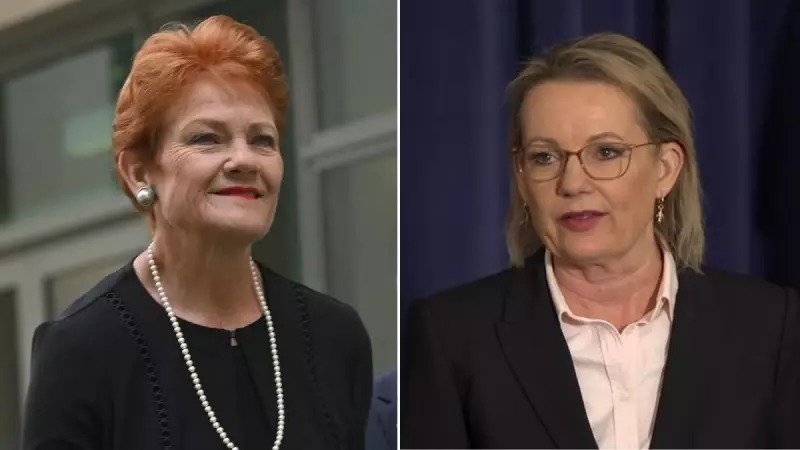
Support for One Nation leader Pauline Hanson continues to grow significantly, with the Queensland senator now surpassing Opposition leader Sussan Ley as the preferred prime minister in fresh polling data. This development marks a notable shift in the Australian political landscape, challenging traditional party dynamics.
Polling Numbers Reveal Dramatic Shift
The new polling data places embattled Liberal Party leader Sussan Ley at just 16 per cent support as preferred prime minister, while Pauline Hanson has surged ahead to reach 26 per cent. Both figures, however, remain substantially below current Labor Prime Minister Anthony Albanese's commanding lead of 39 per cent. The poll of 1,933 Australians was conducted from January 13 to 21, preceding last week's Coalition split announcement.
Primary Vote Breakdown Shows Changing Landscape
When examining primary votes, the data reveals Labor at 30 per cent, One Nation at 24 per cent, the Coalition at 21 per cent, Greens at 13 per cent and Other parties at 12 per cent. Compared with polls earlier in the month, both Labor and One Nation have increased their respective primary votes by 1 per cent, while the Coalition has slipped backwards by 2 per cent.

Election Projections Paint Striking Picture
If these results were replicated at an election held today, analysis suggests Labor would win comfortably but "One Nation would likely become the largest opposition party and therefore become the official opposition," according to George Hasanakos, head of research at data research site DemosAU. Projections indicate Labor would secure 87 to 95 seats, One Nation would capture 29 to 36 seats, while the Liberals would manage just nine to 18 seats.
"These projections demonstrate the dominance of Labor, given the current fragmentation on the right of Australian politics," Hasanakos explained. "With a primary of 30 per cent, the ALP would be on track for a similar majority to the one it currently holds. Meanwhile, One Nation would emerge as clearly the second-largest party, mostly by taking seats off the former Coalition parties."
Historical Context and Constitutional Considerations
Should One Nation overtake Labor and win the next election, it would represent an untraditional, though not impossible, transition from senator to prime minister for Hanson. Typically, Australia's prime minister comes from the House of Representatives. The only precedent occurred in 1968 following the sudden disappearance and death of Prime Minister Harold Holt, when Victorian senator John Gorton became the first and only senator to assume the prime ministership.
Coalition Turmoil and Internal Challenges
The polling comes amid significant turmoil within the Coalition ranks. Nationals Leader David Littleproud announced last week that he "couldn't work" with Ley, revealing his party would split from the Coalition for the second time since last year's election. However, political observers suggest a reunion could be on the horizon as both parties grapple with internal challenges and the rising threat of One Nation's growing popularity.
Queensland Nationals MP Colin Boyce emphasized the electoral implications, telling media that remaining split would be "suicidal for their electoral prospects." Neither Littleproud nor Ley have announced their new front benches as they navigate this complex political environment.
The polling data clearly demonstrates that Pauline Hanson's One Nation is mounting a serious challenge to Australia's long-held Liberal and Labor duopoly, potentially reshaping the nation's political landscape in the coming months.