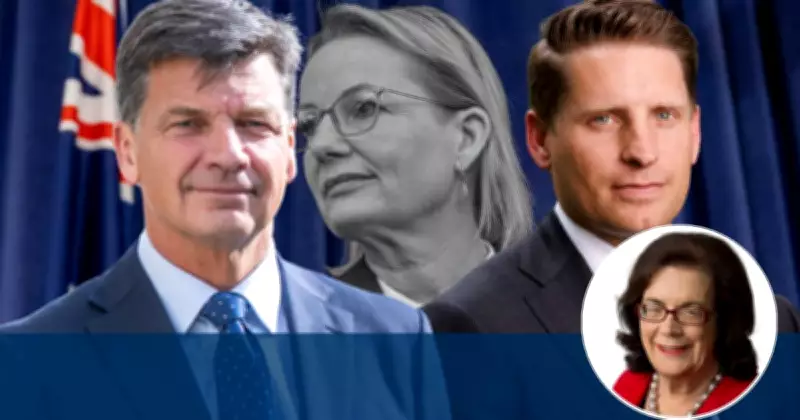
The Liberal Party's internal manoeuvring for a challenge against leader Sussan Ley has been unfolding with remarkable transparency, highlighting deep divisions within the opposition ranks. As party members gathered in Melbourne for a memorial service for former colleague Katie Allen, leadership aspirants Andrew Hastie and Angus Taylor held a highly publicised meeting to discuss their competing ambitions.
A Public Display of Rivalry
Both Hastie and Taylor have declared their intentions to run against Ley, but as right-wing conservatives, they cannot afford to split the vote that would be essential for either to succeed. The timing of their meeting, attended by conservative factional heavyweights James Paterson and Jonno Duniam, appeared insensitive given the memorial service and disrespectful to Ley, whose frontbenchers were involved.
The discussion, held over coffee and pastries, failed to produce a resolution, leaving the Liberals' leadership agony to continue. While Ley's leadership flaws have been extensively analysed, particularly her perceived lack of clear policy stands, the qualities and limitations of her potential replacements have received less scrutiny.

Contrasting Backgrounds and Careers
Angus Taylor: The Economic Dry
Taylor entered Parliament in 2013 representing the New South Wales seat of Hume, immediately hailed as a future leadership prospect. His impressive CV includes winning the University of Sydney medal for economics, a Rhodes Scholarship to Oxford, and a successful business career co-founding an agribusiness and working as a director at management consultancy Port Jackson Partners.
In government, Taylor rose to become minister for industry, energy and emissions reduction under Scott Morrison, and later served as shadow treasurer under Peter Dutton. However, his performance in opposition was considered mediocre by colleagues, and he struggled to land effective blows against Treasurer Jim Chalmers. Taylor's relationship with Dutton was reportedly strained, with private criticisms flowing both ways.
Andrew Hastie: The Military Man Turned Politician
Hastie's path to Parliament could not be more different. A former captain in the Special Air Service Regiment who served with distinction in Afghanistan, he entered Parliament in a 2015 byelection amid the dramatic fall of his patron Tony Abbott. In government, he served as assistant minister for defence before becoming defence spokesman under Dutton, where his performance was considered ordinary.
The relationship between Hastie and Dutton deteriorated, with each blaming the other for the opposition's delayed and insubstantial defence policy. Since the election, both men's leadership ambitions have been obvious, but their tactics have starkly contrasted.
Divergent Strategies and Ideologies
Taylor previously ran against Ley and lost narrowly. In a bizarre move, he encouraged Jacinta Nampijinpa Price to defect from the Nationals to be his potential deputy, a plan that imploded when he failed to secure the leadership. As shadow defence minister, he has maintained a low profile, avoiding any impression of undermining Ley.
Hastie, by contrast, has been more confrontational. Aggrieved at not receiving an economic portfolio, he quit as home affairs spokesman, claiming he wouldn't have a role in formulating immigration policy. He has actively elevated his profile through social media, posting slick, professionally prepared content that sometimes proves provocative.
While both are socially conservative, Hastie leans further right, having been denounced for ill-judged remarks about late-term abortions. Economically, a significant gap exists between them. Taylor, with extensive theoretical and practical knowledge, represents conventional economic dryness, while Hastie has shown nostalgic tendencies, lamenting the demise of the Australian car industry in sentimental terms.
Broader Challenges for the Liberals
Hastie attracts support from impatient younger party members seeking generational change, being 43 compared to Taylor's 59. Critics describe Taylor as having a "born to rule" attitude, while Hastie is often perceived as arrogant.

The reality is that neither contender appears well-suited to lead the opposition in current circumstances, mirroring Ley's own struggles to connect with today's voters. This stems not just from individual limitations but from broader political challenges facing the party.
The Gender Gap and Policy Positioning
The Liberals face significant challenges in attracting female voters from Labor, a demographic crucial for electoral success. Prime Minister Anthony Albanese actively courts this vote through policies targeting women, including childcare improvements, parental leave enhancements, superannuation reforms, and preferential appointments of women to top positions.
The Liberals, regardless of leadership, struggle to compete on these fronts and remain conflicted about issues like work-from-home arrangements. More fundamentally, the party's natural positioning toward smaller government, reduced public spending, and debt reduction conflicts with current voter preferences for expanded government services and direct cost-of-living assistance.
Since the pandemic, concerns about debt and deficits have diminished in public consciousness, leaving the Liberals out of step with contemporary expectations. The times do not suit the Liberals, and the party lacks leaders who can adapt to these changed circumstances, with little indication that either situation will improve soon.