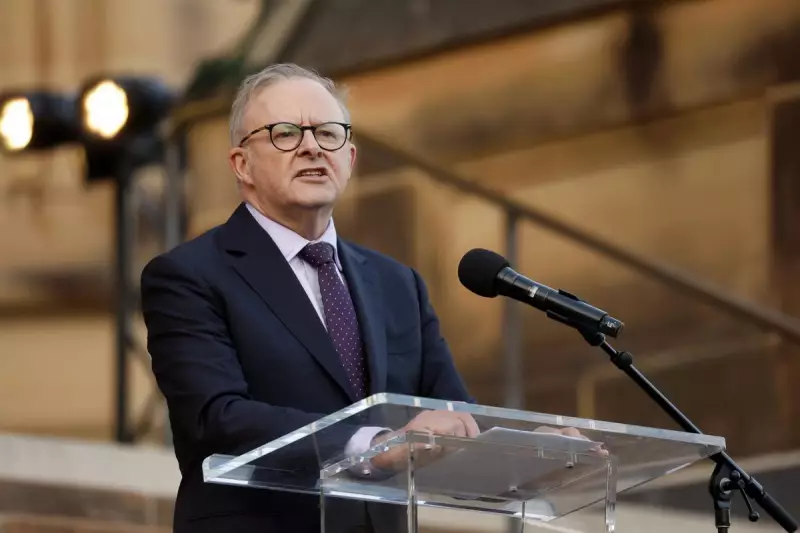
Prime Minister Anthony Albanese faces mounting pressure over the Bondi Junction massacre, yet a full Royal Commission into the tragedy appears to be a political line he is unwilling to cross. The reasons, according to political observers, are fraught with risk for a government already navigating complex political waters.
The Core Political Dilemma for the PM
The horrific attack at Westfield Bondi Junction on April 13, 2024, carried out by 40-year-old Joel Cauchi, left six innocent people dead and shattered a nation's sense of security. In the aftermath, calls for a comprehensive, independent inquiry have grown louder. However, the Albanese government has so far resisted committing to the highest form of investigation—a Royal Commission.
This stance is not born out of indifference but from a calculated assessment of political danger. A Royal Commission possesses sweeping powers to compel testimony and examine evidence without constraint. For a Prime Minister, such an inquiry becomes an uncontrollable force, capable of unearthing systemic failures that extend far beyond the immediate act of a single individual.

The central fear for the government is that a Commission could pivot from the specific actions of Cauchi to broader, more politically sensitive areas. These include the adequacy of mental health service funding, the effectiveness of state and federal law enforcement coordination, and potential gaps in national security monitoring. Any finding of systemic underfunding or policy failure could land directly at the feet of the current federal administration, and by extension, the Prime Minister himself.
Navigating the Blame Game
Albanese's political strategy has instead focused on a measured, multi-agency review. This approach allows the government to demonstrate action while maintaining a degree of control over the scope and findings. The tragic event occurred in New South Wales, a state jurisdiction, which provides a layer of political insulation for the federal government. A state-led inquiry, possibly with federal cooperation, limits the potential for direct federal blame.
Furthermore, the Prime Minister is acutely aware of the precedent. The political fallout from previous Royal Commissions, such as those into institutional responses to child sexual abuse or the banking sector, demonstrated their power to dominate the political agenda for years and inflict lasting damage on sitting governments. For Albanese, already grappling with economic pressures and slipping poll numbers, inviting such a powerful and unpredictable scrutiny is seen as an untenable risk.
The optics are also delicate. The Prime Minister must balance the public's legitimate demand for answers and accountability with the grim reality that no inquiry can ever fully explain an act of senseless violence. There is a political calculation that the public's focus may shift over time, and that a prolonged, headline-grabbing Royal Commission could keep the trauma and associated government scrutiny alive indefinitely.
The Unavoidable Questions and Future Reckoning
Despite the political maneuvering, fundamental questions remain that demand answers. The attacker's known history with mental health issues, his movements prior to the attack, and the precise sequence of events and emergency response all require transparent examination. Victims' families and the broader community seek more than just a clinical report; they seek a guarantee that every possible lesson has been learned to prevent a repeat.
The opposition and critics argue that only a Royal Commission's independence and coercive powers can provide that absolute assurance. They contend that anything less may be viewed as a political cover-up, an attempt to manage the fallout rather than confront hard truths. This creates a persistent vulnerability for Albanese, where any future failure or revelation can be traced back to the decision against a full Commission.

In the end, the Bondi Junction massacre presents Anthony Albanese with a classic political crisis: the conflict between the moral imperative for full transparency and the pragmatic instinct for political survival. His choice to avoid a Royal Commission is a clear signal that his government assesses the political risks of such an inquiry as greater than the potential benefits. Whether the public and the political landscape will allow that calculation to stand is a story that will unfold in the months ahead.