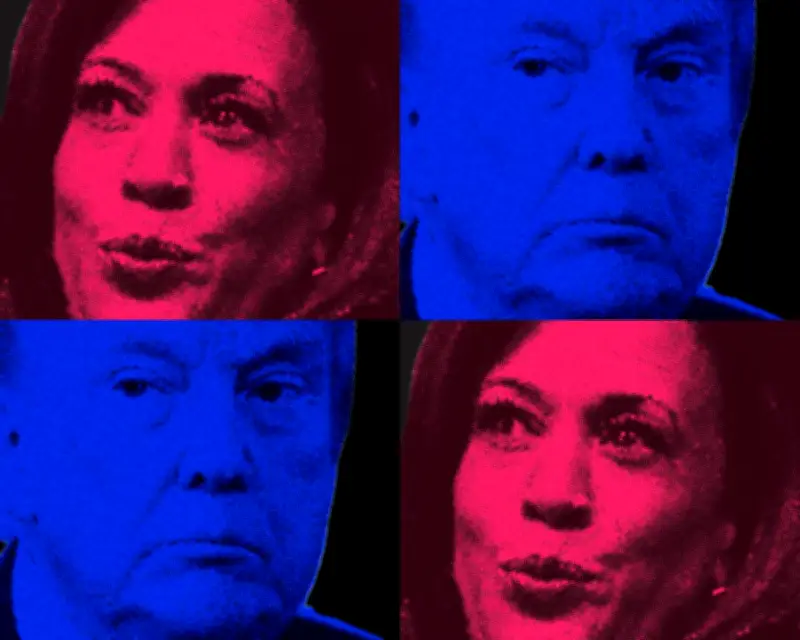
In modern American politics, the association of Republicans with red and Democrats with blue is so ingrained that it seems immutable. Yet this color coding is a surprisingly recent development, solidifying only in the 2000 presidential election and its aftermath. Before that, the assignment of colors to parties was inconsistent across news networks, with some using red for Democrats and blue for Republicans.
The Pre-2000 Era: A Rainbow of Confusion
For decades, television networks had no standardized color scheme for political parties. NBC, for instance, used red for Democrats and blue for Republicans during the 1976, 1980, and 1984 elections. CBS also employed red for Democrats and blue for Republicans in 1980 and 1984. ABC used red for Democrats and blue for Republicans in 1976, but swapped them in 1980. This inconsistency meant that viewers could not rely on color to quickly grasp which party was winning.
The lack of standardization stemmed from the fact that color televisions were still becoming common, and networks prioritized readability over partisan symbolism. Red was often chosen for the incumbent party or the party that held the White House, but this was not a hard rule. The 1992 and 1996 elections saw continued variation, with some outlets using red for Republicans and blue for Democrats, and others doing the opposite.

The 2000 Election: The Turning Point
The 2000 presidential election between George W. Bush and Al Gore marked a watershed moment. The prolonged recount in Florida and the Supreme Court decision that ultimately decided the election kept the nation glued to television screens for weeks. During this period, major news networks, including NBC, CBS, ABC, CNN, and Fox News, all used red for Republican states and blue for Democratic states. This consistency was partly due to a shared data provider, the Associated Press, which supplied color-coded maps.
As the election dragged on, the red-blue map became a ubiquitous visual, reinforcing the association. The phrase “red state vs. blue state” entered the political lexicon, popularized by journalist Tim Russert during NBC’s coverage. By the time the election was resolved, the color scheme had been cemented in the public consciousness.
Why Red for Republicans and Blue for Democrats?
The choice of red for Republicans and blue for Democrats was not based on deep historical symbolism. In fact, red had traditionally been associated with left-leaning parties in Europe, while blue was linked to conservative parties. In the US, however, the decision was largely arbitrary. Some networks chose red for Republicans because the word “red” starts with the same letter as “Republican,” but this was not a universal rationale. The shift to a single standard was driven more by practical necessity than ideological meaning.
Interestingly, the color red had negative connotations for some, as it was associated with communism during the Cold War. Yet, the Republican Party embraced the red label over time, and the Democratic Party adopted blue. Today, the colors are so deeply embedded that they are used in campaign materials, logos, and even everyday language.
The Impact on Political Identity
The solidification of red and blue has had a profound impact on how Americans perceive political geography and identity. The electoral map, with its stark red and blue blocks, reinforces the sense of a divided nation. It simplifies complex regional and demographic variations into a binary, often leading to stereotypes about “red states” and “blue states.” This categorization can overshadow the nuances of political opinion within states and communities.
Moreover, the color scheme has become a tool for partisan branding. Candidates and parties now design their websites, signage, and merchandise around their designated color. The colors also influence media coverage, with news graphics and data visualizations adhering to the red-blue convention.
Despite its recent origin, the red vs. blue framework shows no signs of fading. It has become a shorthand for political affiliation and a symbol of the partisan divide that characterizes contemporary American politics. Understanding its history reminds us that even the most seemingly fixed traditions can be products of relatively recent and contingent choices.