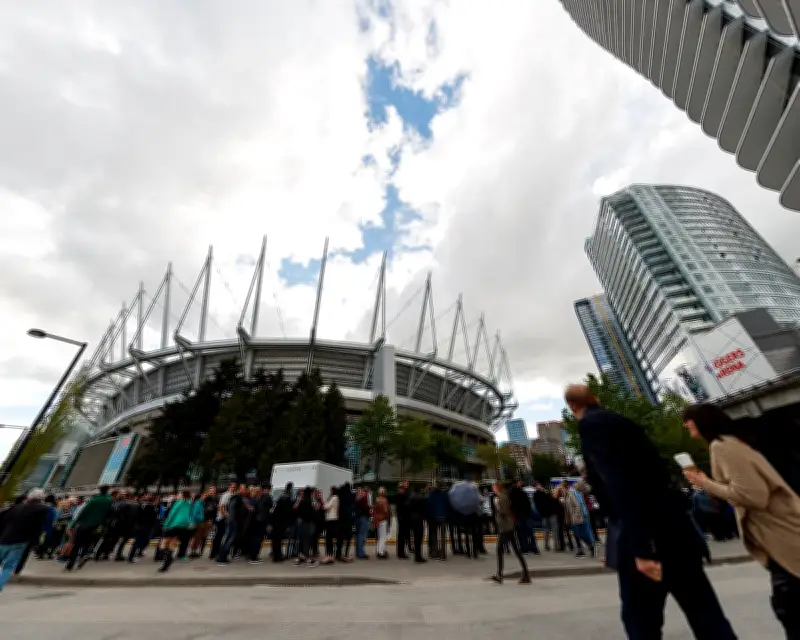
Vancouver’s World Cup has brought a supercharged policing campaign that is putting lives at risk, according to residents and advocates in the Downtown Eastside (DTES) neighborhood near BC Place. On a brisk afternoon on 14 April 2026, Tyson Singh Kelsall was walking to work when he noticed five people lying sedated along the sidewalk on Main Street. He suspected they had used the same poisoned supply, a common occurrence as Vancouver’s drug supply is increasingly contaminated with sedatives like benzodiazepines.
What he saw next alarmed him. Vancouver police officers arrived before an ambulance and worked their way down the row, yanking each person toward the building wall. None checked breathing or asked if they needed help. After dragging them from the road edge, the officers left. Singh Kelsall, who trains people in overdose responses, knows that roughly hauling someone sedated by opioids and benzos is dangerous. Proper positioning, airway checks, and staying until help arrives are critical.
“What do they think moving people just five feet will solve?” asked Singh Kelsall, a researcher with Police Oversight With Evidence and Research (Power) at Simon Fraser University. “Everyone knows it’s not preferable for people to sleep on the sidewalk. But this puts people at risk of injury.”

Community monitoring of police interactions
Power has documented police interactions in the DTES since July 2024. They hold weekly community drop-in sessions where residents report violence, aggression, or intimidation by law enforcement. Trained members also conduct observations twice a week. The area under monitoring, less than a square kilometer, is the epicenter of the city’s housing, drug, and mental health crisis and sits adjacent to BC Place, a host stadium for the World Cup.
The DTES, home to low-income residents, Indigenous populations, and people experiencing homelessness, is one of Canada’s most overpoliced communities. A 2018 CBC investigation found residents had the highest fatality rate during police encounters in Canada. Police practices there increase overdose risk by pushing people away from supervised consumption sites, according to a BC Centre of Substance Use study.
Since the start of 2026, Power has documented an uptick in aggressive practices. Community members blame the World Cup. Singh Kelsall said it is now routine for teams of police officers, sometimes with city workers, bylaw officers, and occasionally a housing worker, to patrol the main corridor up to eight times a day. Power has documented cases of officers detaining and handcuffing people while searching bags, threatening tickets for questioning, and issuing $250 fines for smoking cigarettes.
Red-zoning and displacement
This practice of imposing geographic restrictions to exclude individuals from an area is called “red-zoning,” said Nicholas Blomley, professor of geography at Simon Fraser University. “The net effect can be profound on people’s wellbeing, health, and ability to access vital resources and community, including friends and partners.”
For the World Cup, Vancouver has allocated at least $242 million from an estimated total budget of $685 million to $729 million for integrated public safety, traffic management, and stadium management. Deputy police chief Don Chapman expects it to be the city’s largest police deployment. Infrastructure has been enhanced over 16 months. In February 2025, Mayor Ken Sim announced Task Force Barrage, a $5 million integrated deployment of police, firefighters, bylaw officers, and sanitation crews, billed as a crackdown on organized crime. In January 2026, the Vancouver Police Department created District 5, a new policing district with 88 officers covering the DTES and surrounding areas.
The city insists these decisions are unrelated to the World Cup, but community members find it hard to distinguish. “I don’t know if it’s related to Fifa. But wanting residents to move so other people can walk down the sidewalk—to me, that’s it,” said Singh Kelsall. “It’s linked to Task Force Barrage, District 5, trying to show visual impacts before the tournament.”

Temporary bylaws and historical patterns
In April 2026, police issued a $1,000 street-vending ticket to a senior resident weeks before formal restrictions took effect. A temporary bylaw from 13 May to 20 July, coinciding with the World Cup, expands city powers over street vending, noise, graffiti removal, and management of public space within two kilometers of the stadium, aiming to ensure a “clean and welcoming environment” for Fifa.
“Now that Fifa’s coming, it’s like every time you turn a corner, there’s a cop jacking somebody up,” said Samona Marsh, a DTES resident for over 30 years, secretary of the Vancouver Area Network of Drug Users, and a community researcher at Power. She recalls similar “cleanups” during the 2010 Winter Olympics, when police issued twice as many tickets for bylaw infractions, 95% within a four-block radius of the DTES. Residents unable to pay faced arrest warrants and no-go orders. During Expo 86, over a thousand low-income residents were evicted from single-room-occupancy hotels.
But the drug supply has changed drastically. Since British Columbia declared a public health emergency in 2016, over 18,000 people have died from toxic drugs. The DTES death rate in 2023 was more than 12 times the provincial average. The supply now includes sedatives requiring intervention beyond naloxone. Displacement severs people from peers, harm reduction workers, and supervised consumption sites that could save lives.
“While displacement might have ruptured communities 30 years ago, now it can mean life or death,” said Singh Kelsall. “You displace someone to an unfamiliar area, and they could die.”
Legal system strain and future concerns
For those taken into custody, uncertainty looms. The BC Supreme Court chief said Fifa’s demand for police resources makes normal court proceedings nearly impossible for almost a month. What happens to people ticketed, detained, or arrested when courts are limited remains a mystery to Marsh. “There’s going to be a whole lot of people that are either red-zoned or in jail,” she said. “Especially since there’s going to be no courts.”
The Vancouver Police Department denied any change in approach, stating community concerns about displacement and policing style are “often without factual basis.” “We are not changing our approach due to Fifa and are consistent in our interactions with the community,” the VPD said in an email. They added that the 50% increase in officers through Task Force Barrage and District 5 was necessary due to high crime rates in the DTES. “Task Force Barrage confirmed that high visibility policing has a positive effect on violent crime statistics and perceptions of public safety,” the VPD said.
Mayor Ken Sim has stated that displacement of unhoused people will not occur because of Fifa. When a motion about the security environment was raised at city council, former VPD spokesperson and councillor Brian Montague characterized community concerns as “fear-mongering.”
But Delilah Gregg, president of Western Aboriginal Harm Reduction Society and a Power founding member, questions what comes after. “Once the games are done, will we all of a sudden see less of them? Or will it stay the same?” said Gregg, a Nak’azdli First Nation member who has lived in the neighborhood for decades. She has witnessed the impacts of increased police violence. “I think for a lot of people, especially Indigenous people, having some cop tackling you down can be really harsh and jarring,” she said. It can trigger trauma from residential schools or involuntary treatment programs. “They don’t realize how much trauma that is and how it can affect a person, especially when they’re not ready to.”
Blomley, who researched during the Olympics, has seen the practice continue long after the torch passed. “It’s important to recognize that this is part of an ongoing process of criminalization and control,” he said. “When the football fans go away, the red zones will still be there, people’s stuff will still be being taken illegally from them.”